
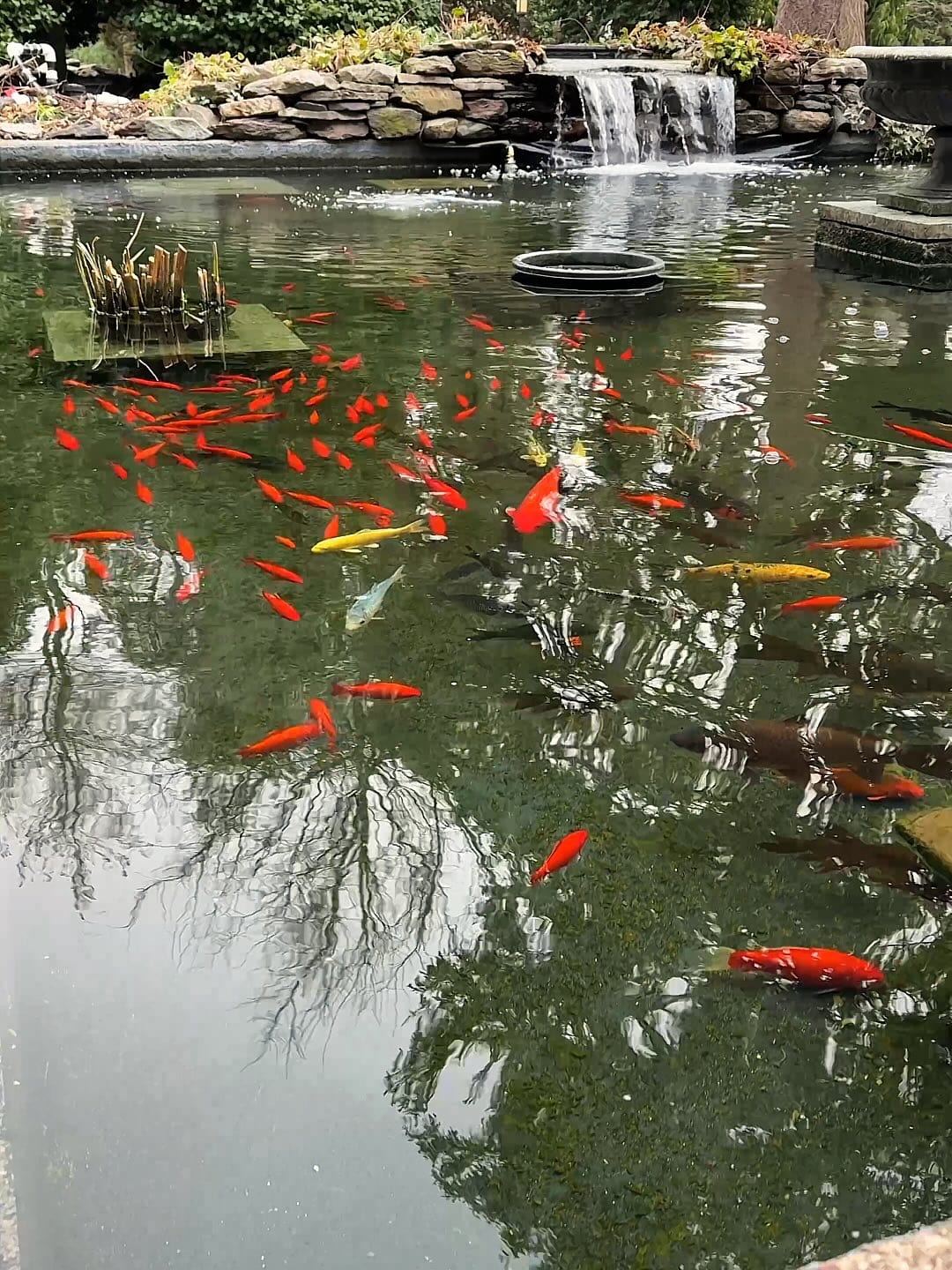
5 Facts About Koi Fish You Didn't Know
They live longer than your car, see more colors than you do, and one of them sold for nearly two million dollars. Meet the most fascinating fish in the backyard.
The fish that started a 200-year obsession
Most people think of koi as "those big colorful fish in the fancy pond." But once you spend a little time with them — feeding them, watching them, learning where they came from — you realize koi are some of the most surprising, intelligent, and downright impressive animals you can keep in a backyard. Here are five facts that catch almost everyone off guard.
A single koi once sold for $1.8 million
Yes — million, with an M.
In 2018, a nine-year-old female koi named S Legend was sold at auction for roughly $1.8 million USD, making her the most expensive koi ever sold. Top-grade Kohaku and Sanke bloodlines from Japan are treated like living art — judged on body shape, skin quality, pattern balance, and even the way they swim.
Why it matters for your pond
You do not need a million-dollar fish to enjoy koi. A handful of healthy, well-chosen koi from a quality supplier is plenty to bring a backyard pond to life.
Koi can live longer than your dog, your car, and possibly you
The oldest known koi lived to be 226 years old.
A scarlet koi named Hanako, owned by a Japanese family, was confirmed to be 226 years old when she passed away in 1977 — her age verified by counting growth rings on her scales (yes, like a tree). Most well-kept backyard koi will live 25 to 50 years, often outlasting the people who first dug the pond.
Why it matters for your pond
When you build a koi pond, you are not buying a pet — you are starting a multi-generational family member. That is part of why we build them to last.
Your koi actually recognize you
They learn your face, your footsteps, and your feeding schedule.
Koi are surprisingly intelligent. Studies have shown they can be trained to associate specific sounds, colors, and even faces with food. Many of our clients tell us their koi swim to the surface the moment they hear the back door open — and ignore strangers entirely. Some koi will even let their owners hand-feed them or gently stroke their backs.
Why it matters for your pond
A koi pond is not a fish tank you look at. It is a relationship. The longer you have your koi, the more personality they show.
They see more colors than you do
Koi have four-color vision — humans only have three.
While humans see in red, green, and blue (trichromatic vision), koi are tetrachromatic, meaning they can also perceive ultraviolet light. They can distinguish subtle color differences in their environment that we cannot even imagine — including in their own brilliantly patterned scales. They also have excellent hearing and can sense vibrations through their lateral line, picking up footsteps long before they see you.
Why it matters for your pond
When we design a koi pond, we think about what the koi see — light angles, shadows, hiding spots — not just what looks pretty from the patio.
There are over 100 named koi varieties — and they all started as common carp
Every koi alive today traces back to a plain gray fish farmed for food.
Koi were first bred in Niigata, Japan in the early 1800s by rice farmers who noticed color mutations in the carp they were raising for food. Two hundred years of careful breeding later, there are now more than 100 officially recognized varieties — Kohaku (red and white), Showa (black, red, and white), Ogon (solid metallic), Asagi (blue-scaled), Butterfly koi with long flowing fins, and many more. Each variety has its own pattern rules and judging standards.
Why it matters for your pond
When we help you stock your pond, we mix varieties for color contrast, movement, and personality — so the surface of your water is always visually interesting, no matter the season.
Five more quick koi facts to drop at your next dinner party
Because once you start learning about koi, it is hard to stop.
Koi can grow up to 3 feet long in a properly sized pond.
They have no stomach — food passes straight through their intestines, which is why feeding the right amount matters.
Koi go semi-dormant in winter and stop eating entirely below 50°F.
A healthy koi pond should be at least 1,000 gallons and 3 feet deep — anything smaller stresses the fish.
Koi are technically a kind of carp (Cyprinus rubrofuscus), not goldfish — though they are distant cousins.
Koi are not just decoration — they are a story you live with
The clients who love their koi pond the most are the ones who fall for the fish themselves — naming them, learning their personalities, watching them grow year after year. A koi pond is one of the few backyard investments that gets morerewarding the longer you have it.
If that sounds like something you want in your yard, the next step is easy: let's talk about what a koi pond would look like at your home.
Frequently asked questions
Dreaming of a koi pond of your own?
Every great koi pond starts with a conversation. Tell us about your yard, your style, and what you imagine — we'll handle the rest.