
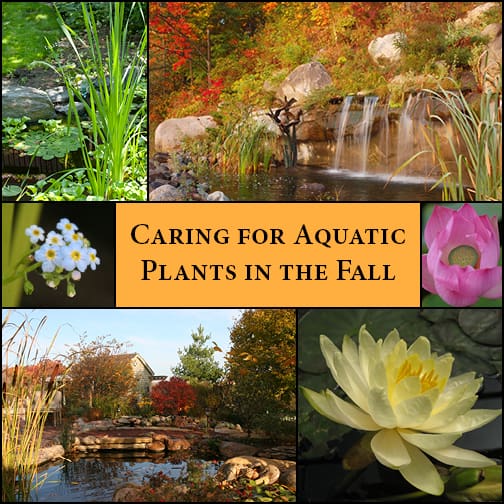
Pond plants are the part of fall prep people either overdo or skip entirely. Neither is right, and the correct answer is different for each type of plant you have.
The Philadelphia area sits in USDA zone 7, which matters here. It is cold enough that tropicals will not survive outdoors, and mild enough that hardy plants come through winter in the pond without any help at all. Most of the fall plant advice online is written for either Florida or Minnesota, and neither applies.
Here is what to do, plant by plant.
Hardy marginals: trim and leave them
Cattails, iris, rushes, pickerel, sweet flag. These are the perennials of the pond and they behave like any other perennial in your yard.
Stop fertilizing once you see leaves start to yellow and brown. Then trim the dying foliage down to about 2 inches above the water line.
Leave the plants where they are. They do not come inside, they do not need to be moved, and they will come back in spring. The trim is not cosmetic: foliage left standing flops over into the water, sinks, and rots there, which is exactly the organic load you spent the fall removing.
Hardy waterlilies: cut back, then sink them
Waterlilies announce the cold before you feel it. Leaves yellow, flowers get smaller and less frequent.
When that starts, cut the leaf and flower stems back to 2 or 3 inches above the base of the plant. Then move the pot to the deepest part of the pond so the crown sits below where ice will form.
Do not bring hardy lilies indoors. They need a cold dormant period, and a winter spent in a warm basement is worse for them than a winter under the ice.
Tropical waterlilies: indoors, or treat them as annuals
Different plant, opposite instruction. Tropicals are only happy above about 60 degrees, so in zone 7 they will not survive outside.
If you want to keep one, bring it in. Hold the pot in water around 50 degrees, or lift the tuber and store it in damp sand somewhere cool and dark.
Be realistic about the odds. Overwintering tropical waterlilies is genuinely difficult and even experienced growers lose a good share of them in storage. A lot of pond owners buy new ones each spring and consider it the cost of having them. That is a reasonable decision, not a failure.
Lotus: wait until it is brown
Lotus has one rule that catches people out: do not cut the leaves while they are still green.
A freshly cut green lotus stem is hollow and open, and disease travels straight down it to the tuber, which can kill the whole plant. Wait until the foliage has died back and gone brown on its own, then trim.
Lotus tubers will not survive freezing. If yours is sitting in a shallow shelf, move it to the bottom of the pond where the water will not freeze solid.
Tropical marginals: houseplants or annuals
In zone 7 these get replaced each season, the same as any garden annual.
If you would rather not buy them again, they make surprisingly good houseplants. Pot them in heavy garden soil in a sealed container with no drainage holes, keep them wet, and put them in a sunny window or a sunroom. Many will hold through to spring.
The short version
| Plant | What to do |
|---|---|
| Hardy marginals | Trim to 2 inches above water, leave in pond |
| Hardy waterlilies | Trim to 2 to 3 inches above base, sink to deepest point |
| Tropical waterlilies | Bring indoors at 50F, or replace in spring |
| Lotus | Wait until brown, then trim. Move off shallow shelves |
| Tropical marginals | Replace each season, or overwinter as a houseplant |
Stop fertilizing everything after the first frost.
Where this fits in the rest of fall
Plant work is one step in a sequence that runs on water temperature rather than the calendar, and the order matters. Netting goes up before leaf drop, plants get trimmed in the 55 to 50 degree window, and feeding stops at 50. The full sequence is in our fall pond care checklist.
Doing the plant work properly in October is the difference between a pond that clears up on its own in April and one that needs a full cleanout. Get in touch if you would rather hand it off. We serve Philadelphia, Bucks, Montgomery, Delaware and Chester counties, and South Jersey.