
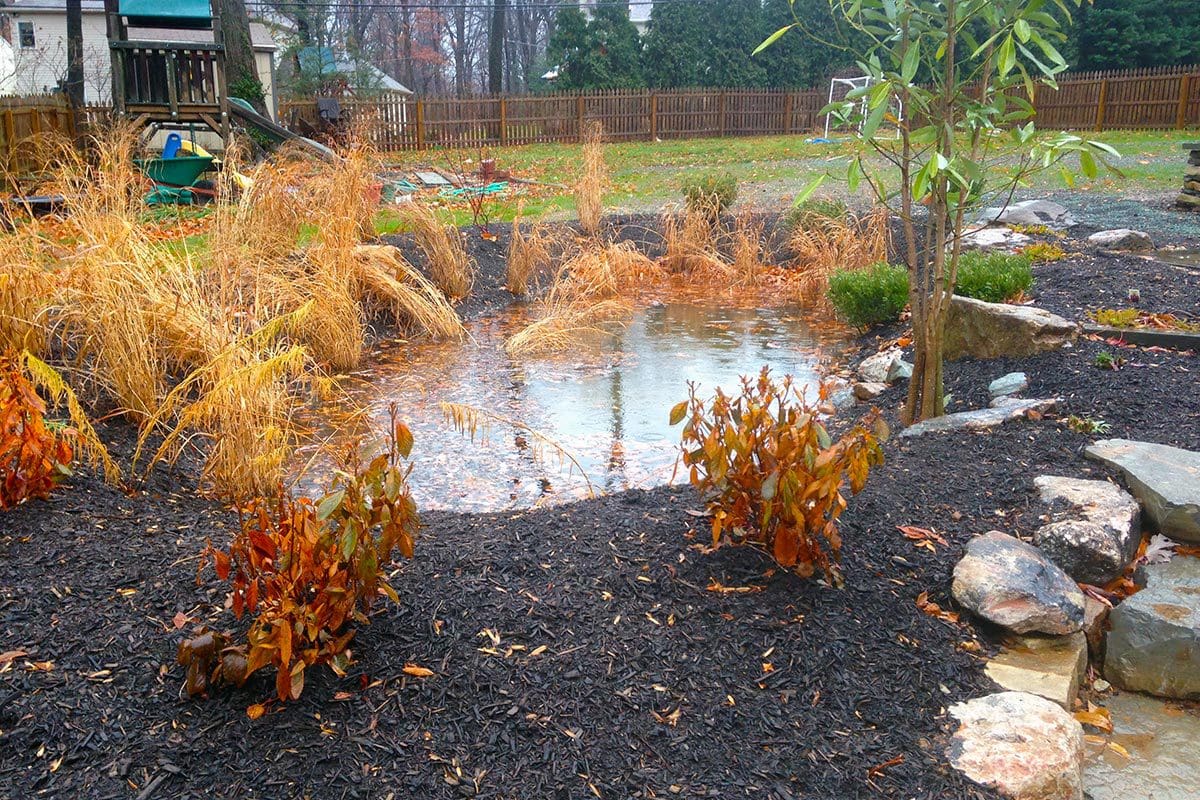
Somewhere on a lot of commercial properties, HOA commons, and township parcels around Philadelphia there is a basin that was built as a condition of approval, signed off on, and then quietly forgotten for twenty years. It is usually nobody's job until it is suddenly everybody's problem.
Here is what you need to know about the thing at the bottom of the property.
Retention or detention, and why the words matter
A retention basin holds water permanently. It has a standing pool, it functions as a pond, and it is managed like one: water quality, aeration, vegetation, shoreline.
A detention basin is dry most of the time. It catches a storm surge, holds it, and releases it slowly through an outlet structure so that downstream systems are not overwhelmed all at once. It is engineered around a release rate.
They fail in different ways and they get maintained differently, so a contractor who uses the terms interchangeably is telling you something.
How they fail
Sediment. The basin is doing its job, which means it is catching the silt that would otherwise go downstream. Over years that accumulates, and the design volume quietly disappears. A basin at half its design capacity does half its job.
Outlet structures. Risers, orifices and trash racks clog with debris and sediment. When the outlet fails, a detention basin stops detaining and starts either flooding or discharging at the wrong rate.
Bank erosion. Slopes without established vegetation rill and slump, which dumps more sediment into the basin and creates a safety and mowing problem at the same time.
Vegetation, in both directions. Too little and the banks erode. Too much of the wrong kind, meaning woody growth on an embankment, and root systems compromise the structure itself.
Nuisance conditions. Standing water where there should not be, algae, odor, and mosquitoes. This is the one that generates resident complaints, and complaints are usually how these get discovered.
What inspections look for
Generally: is the design volume still there, does the outlet function as designed, are the embankments sound, is vegetation appropriate, and is there documentation showing it has been maintained. That last one catches people. Having done the work matters less than being able to show you did.
The part that gets overlooked
A basin does not have to look like an accident. The same site can be handled purely as compliance, or it can be handled as an amenity: stabilized banks, appropriate native plantings, an aeration fountain that solves an oxygen problem and happens to look like something. Residents stop complaining about the retention pond and start liking it.
That is a real difference in what a property feels like, and it usually does not cost much more than doing the minimum badly.
Why us
We have been building and maintaining water since 2000, on both the residential and the commercial side. Aeration, sediment, shoreline, plantings and the appearance of the thing are the same skills either way. See stormwater management, stormwater ponds, and lake management, or read the broader stormwater and drainage guide.
Inherited a basin and not sure what shape it is in? We will come look at it.