
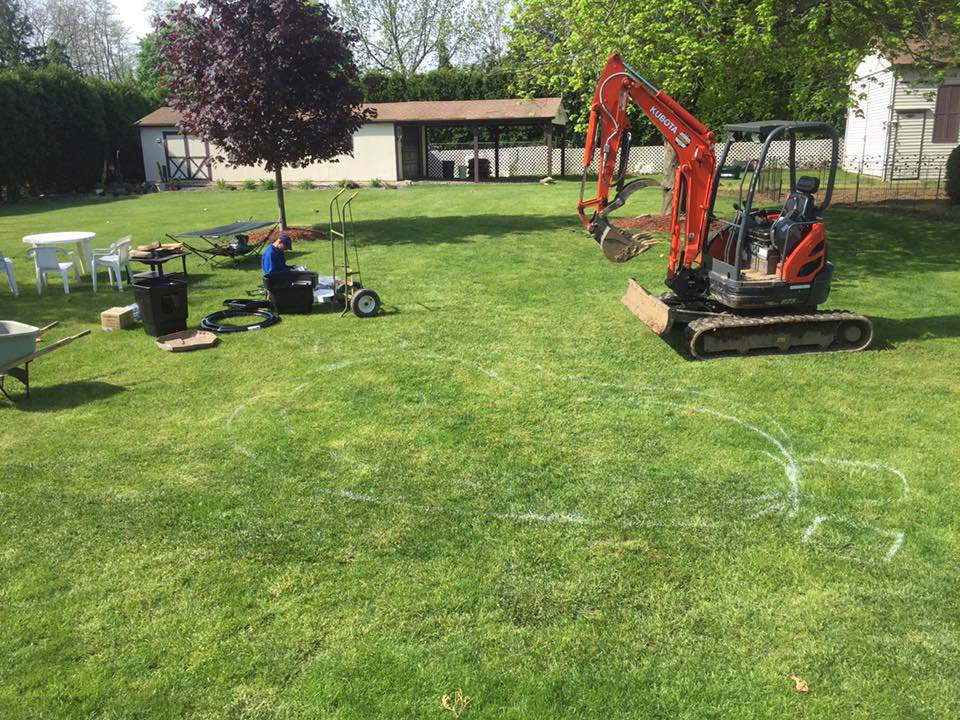
Every yard has a story underground, and in Southeastern Pennsylvania that story changes from one town to the next. A pond in a Bucks County yard with heavy clay is a different build from one in a Montgomery County yard where we hit rock at two feet, and both are different from a low corner of a Delaware County lot where groundwater sits just under the grass.
None of these conditions rule out a pond. They do change how it should be designed, how it should be dug and how long the job takes. Here is what we look for before the first shovel goes in, and why it matters for how your pond performs for the next twenty years.
Clay soil
Much of our region sits on clay or clay heavy soil. It is good news and bad news.
The good news: clay holds its shape. Shelves and walls dug in clay stay where they are cut, which makes for clean, stable edges.
The bad news: clay does not drain. Rain that hits a clay yard runs across the surface until it finds a low spot, and if that low spot is your pond, it brings silt, mulch and lawn treatments with it. Clay also swells when wet and shrinks when dry, which can shift edge stones over time if they were not set on a firm base.
How we build for it: the pond edges are raised slightly above the surrounding grade so surface runoff goes around the pond, not into it, and the edge stones are set on compacted base rather than loose fill. Where a yard has a real drainage problem, we fix it first. Our stormwater drainage guide covers what that can look like.
Rock and shallow bedrock
In parts of Montgomery and Bucks counties, the excavator hits rock sooner than anyone would like. Sometimes it is a layer of loose shale that breaks up with effort. Sometimes it is solid ledge.
What it changes: depth. If your plan calls for a deep koi pond and there is ledge at two feet, we either work with it or work around it. Options include shifting the pond to a spot with more soil, building up instead of down with raised walls or berms, or designing the deep zone where the rock allows. Fish need enough depth to stay comfortable year round, and our post on how deep a koi pond should be explains what that really means.
What it does not change: whether you can have a beautiful pond. Some of the most natural looking waterfalls we have built started with a rock problem that became part of the design.
High water tables and wet spots
A low corner of the yard that stays soggy in spring looks like a natural place for a pond. Often it is, but it needs a careful build.
The problem: when groundwater rises higher than the water in the pond, it pushes up from below. That can lift the liner off the floor in a bubble, sometimes called liner float, and it can make it nearly impossible to drain the pond for a cleanout in spring.
How we handle it: we look at the site in different seasons when we can, and we ask homeowners where water sits after a heavy rain. On wet sites we may add drainage beneath and around the pond to relieve that pressure, adjust the depth, or move the pond a little higher on the property. Sometimes the wet spot is better suited to a rain garden or a stormwater feature, which our stormwater management team designs.
Roots and mature trees
Older neighborhoods mean big trees. A pond placed under a mature oak or maple will be fighting roots below and leaves above for its entire life. Roots push against the liner, and leaf drop fuels the muck that leads to cloudy water and fall headaches.
We do not tell people they cannot have a pond near trees. We do look for the spot that balances shade, sight lines and root pressure, and we lay a protective underlayment beneath every liner so roots and rocks are not working directly against it. The bigger picture of choosing a location is covered in our pond siting guide.
Access: can the equipment get there?
This is the one people do not think about until the excavator is in the driveway. A pond build means moving a lot of soil out and a lot of stone in. That usually takes a compact excavator and loaders, which need a path into the backyard.
Narrow side yards, fences, septic fields, retaining walls and steep slopes all affect access. Most of the time there is a way in, sometimes by removing a fence panel or laying ground protection over the lawn. On tight properties, some of the work may be done with smaller equipment or by hand, which adds time. Access is one of the reasons an honest proposal is written after someone has seen the property, and our post on pond estimates vs quotes explains how that works.
Utilities and permits
Before any digging, utility lines have to be marked. In Pennsylvania that means a call to 811 a few business days ahead so the gas, electric, water and communication lines are located. Underground irrigation lines, invisible dog fences and landscape lighting wires are not marked by 811, so it helps to tell us where those run.
Some townships also have rules for ponds above a certain size or depth, or near property lines. Our post on Pennsylvania pond building permits covers what to check.
Why site conditions matter long after the build
Every one of these conditions shows up later if it is ignored. Edges that were set on loose fill settle. Runoff that was never redirected keeps clouding the water. A liner on a wet site floats every spring. When a pond starts having problems five years in, the cause often goes back to something underground that was never accounted for.
That is the real value of experience in this trade. After more than 25 years of digging in Greater Philadelphia, we have a good idea of what is likely under a yard before we start, and a plan for what to do when we are surprised. You can see how the whole process unfolds in what happens during pond installation, week by week.
If you are thinking about a pond and want to know how your yard's conditions affect the design, Start a Conversation or call us at 215-880-6811. Tell us a little about the property, and we will talk through what is likely to matter before anyone picks up a shovel. Our koi and fish pond page is a good place to see what the finished result can look like.