
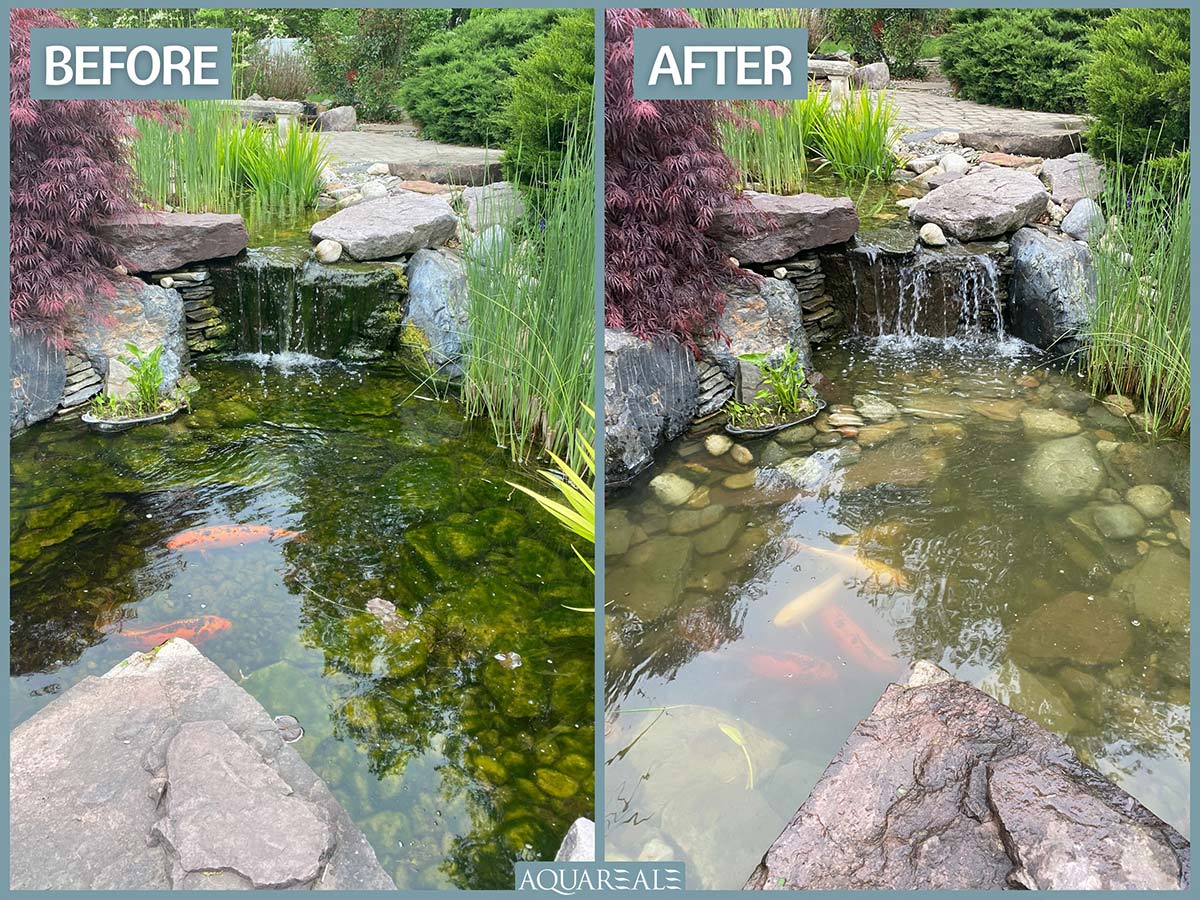
Algae is the most basic plant on the planet and it is the single biggest maintenance frustration most pond owners have. It is also, in small amounts, a sign your pond is working.
Knowing which situation you are in is most of the battle. Here is how to tell, what causes the bad version, and how to clear it.
The two kinds you will see
Suspended algae, usually called green water, is single-celled and reproduces fast. The cells are small enough to pass straight through most filtration. Under the right conditions there can be millions of cells per milliliter, and left alone it turns a pond opaque green.
String algae, also called hair algae, grows in long filaments that cling to rocks and plants. Left alone the strands tangle into mats that can double in weight in 24 hours.
They have different causes and different fixes, which is why one treatment rarely handles both.
Some algae is normal
A thin green coating on the rocks and pond walls is fine. That is a working ecosystem, and scrubbing it off accomplishes nothing except making the rocks look raw.
The goal of treatment is never to eliminate algae. It is to rebalance the relationship so algae is a background player instead of the main event. If the water is turning green or filaments are clogging the stream, that is the point to act.
Why spring is the worst
Every year, the same thing. Temperatures warm, nutrients are plentiful, and the days get longer. Meanwhile the water lilies and irises have not woken up from winter, so nothing is competing with the algae for those nutrients.
The result is a spring bloom where algae is the only organism actively working. Most of these clear on their own once the water warms enough for plants and fish to resume activity. If yours does not clear by early summer, something else is feeding it.
The six things that prevent it
Almost every persistent algae problem traces back to one of these.
Keep the fish load reasonable. More than 10 inches of fish per 100 gallons and your pond is overstocked. Fish waste is a nutrient source, and too many fish means more waste than the system can process.
Do not overfeed. Uneaten food decays in the pond and feeds the algae directly. Feed no more than once a day, and no more than the fish clear in two to three minutes. Scoop out whatever is left.
Get the plant coverage right. At the peak of the season you want 40 to 60 percent of the pond surface covered or shaded by plants. Plants compete with algae for the same nutrients and cut the sunlight algae needs. Going much past 60 percent creates its own problem: at night plants consume oxygen and release carbon dioxide, and too much coverage can pull dissolved oxygen down.
Size the pump correctly. You want the entire volume of the pond circulating at least once an hour. Check that debris is not restricting the flow, and do not ask a pump to lift water higher than it was built for. Every pump has a flow curve and pushing past it costs you turnover.
Upsize the filtration. Filters are rated under ideal conditions. Real ponds are not ideal. Always size the filter above your pond's actual capacity rather than right at it, and clean it on the manufacturer's schedule.
Watch the temperature. Above 75 degrees Fahrenheit water holds dissolved oxygen poorly. Plant shade helps. If you see fish at the surface gasping during a heat wave, add aeration.
Removing string algae
Physical removal first, always. Do this before any treatment, because killing a mat of algae in place just converts it into a load of decaying organic matter that feeds the next bloom.
Grab the strands near the base and pull hard, into a bucket. Winding it around your hand works better than anything else, because the strands are thin and soft and they do not release cleanly from brush bristles. Gloves are optional and will keep you cleaner. For algae down deep, a long-handled brush will reach it.
Sooner is better. Once the strands release spores into the water, the problem restarts on a clock.
What we use, and what we do not
We do not recommend algaecides. They are sold as safe for fish and plants, and we still will not put them in a customer's pond. They treat the symptom, they kill algae in place so the decay load goes right back into the water, and they do nothing about the reason the algae was there.
What we use instead is bacteria and enzyme treatments. Beneficial bacteria consume the organic debris and nutrients that algae feed on, which removes the fuel rather than burning the crop. Aeration supports that: running it continuously improves circulation and dissolved oxygen, and aerobic bacteria work harder with more oxygen available.
For ponds that need consistent treatment, a dosing system works like an IV, metering algae control in on a schedule instead of relying on somebody remembering. A UV clarifier is the other tool, and it is genuinely effective against suspended green water because it kills the free-floating cells as they pass through.
Find what is feeding it
If algae keeps coming back after removal, stop treating and start testing. High pH and high phosphorus are the leading causes of persistent string algae.
pH climbs from clearing algae blooms, heavy plant growth, overstocking, and foreign material leaching into the water. Untreated concrete and rock containing limestone, calcium or granite will all push pH up.
Phosphorus usually comes from fertilizer running into the pond. Iron is another contributor. So are grass clippings, which is the one nobody thinks about: mow toward the pond and you are feeding it every week. Scoop green clippings out immediately.
The broader fix is keeping nutrients out in the first place. Organic debris, leaves and fertilizer are loaded with them. A buffer of planting around the pond edge intercepts runoff before it reaches the water.
Add plants that outcompete it
Fast-growing, heavy-feeding plants take the nutrients before algae can. Pull the decaying plants out first, since those are adding to the problem rather than helping.
For spring and summer here we recommend water lettuce, irises and cattails. Water lilies and hyacinths do double duty, competing for nutrients while shading the surface. Just check anything new for string algae before it goes in, because the fastest way to reinfect a pond is to drop in a plant carrying it.
When it is a maintenance problem
There is a line between a pond that blooms each spring and clears, and a pond that is green all season. The second one is telling you something structural is wrong: undersized filtration, too many fish, a pump that is not turning the volume, or nutrients coming in faster than the system can process them.
That is a diagnosis worth getting right, because you can spend years treating a problem that a correctly sized filter would have ended.
If you would rather not deal with it
We do pond algae control and pond cleaning across the Philadelphia area, on ponds we built and ponds we did not. Cleaning a pond with fish in it is not a pleasant job, and it is one we are happy to take off your hands.
Get in touch and we will take a look at what is actually driving it.