
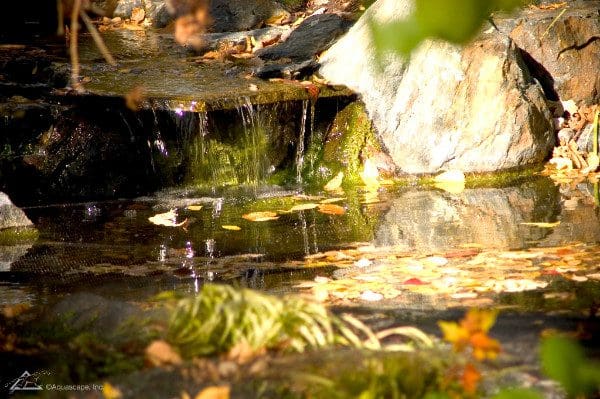
You walked out with your morning coffee, looked at the pond, and it is the color of iced tea. Or worse, chocolate milk.
First, breathe. Brown water almost never means something is wrong with your fish. Most of the time it is cosmetic, and most of the time it is fixable in an afternoon. But you have to know which kind of brown you are looking at, because the two causes have opposite fixes.
Tea-colored and muddy are different problems
Clear but tinted, like weak tea. Those are tannins. Leaves, pine needles, acorns, a stray piece of driftwood, anything organic that sits and steeps will leach brown into the water exactly the way a tea bag colors a mug. This is why it shows up every autumn. Harmless to koi, just not the look you signed up for.
Cloudy and muddy, like someone stirred the bottom. That is suspended sediment. A heron wading through at dawn, a raccoon on a midnight raid, hard rain washing soil in, or your own fish rooting through the sludge after a big feeding. The underlying cause is usually years of leaves that sank, decayed, and became muck on the pond floor.
Both come back to the same root: too much organic matter in the pond. They just present differently.
The mason jar test
If you cannot tell by looking, this settles it, and all you need is a glass from the kitchen.
Fill a clear glass or mason jar with the pond water and leave it somewhere undisturbed for 24 hours. Then look at it.
- Water clear, sediment settled on the bottom. You have a sludge problem.
- Water still brown, nothing settled out. You have tannins.
That one test tells you which half of this article applies to you.
Clearing tannins
A partial water change paired with fresh activated carbon in your filtration is the fast route. Carbon pulls the color straight out, and it works quickly.
Then deal with the source, or you will be doing it again in three weeks. Skim the surface, pull the debris out, and if you have a tree that dumps into the pond every October, netting through leaf season saves you the entire problem.
Clearing sludge and sediment
Patience and good filtration handle most of it once things settle, assuming the disturbance was a one-off like a storm or a heron.
If it keeps clouding back up, that is your answer: there is more muck on the bottom than your system can keep up with. No treatment fixes that, because you are treating a symptom that regenerates every time a fish swims through it. You can pull sludge out by hand, and some pond owners genuinely enjoy any excuse to get in the pond, but at a certain volume it becomes a job.
That is when a proper pond cleaning earns its keep. We vacuum the muck out, rinse the rocks, check the pumps, and hand you back water you can see your koi through.
Preventing it
Debris management is the whole game, and it is a few minutes at a time rather than one big effort.
A mechanical skimmer is the single most useful piece of equipment here, sweeping fallen leaves and sticks off the surface before they sink. Check the basket more often during fall and empty it as needed. It takes seconds.
The leaves that get you are the ones the skimmer never sees. Debris collects around the edges, and leaves hide underneath lily pads and other floating plants where the current never reaches them. Those are the ones that sink, decay, and become next year's sludge. Pull them out by hand when you spot them.
Our seasonal maintenance visits exist to stay ahead of exactly this, and the fall cleanout is where most of it gets handled in one pass.
When the real answer is the filtration
Years of buildup sometimes means a full clean-out, and it is worth asking a harder question at the same time: was the filtration ever sized correctly for this pond?
A pond that goes brown every season despite regular cleaning is usually a pond whose system cannot keep up with its actual load. That is a fixable problem, but it is a different fix than another bottle of treatment.
"I have a mid-size koi pond (3,000 gallons) that I'd maintained for years, but didn't have time for the major clean-out and startup this spring. They did a phenomenal job, caring for my fish, cleaning the rocks and waterfall, getting the pumps working right. They worked nonstop for almost 12 hours. My pond has never been clearer. Highly recommend!"
Todd P., Google review
Not sure which brown you are looking at
Run the jar test, or just send us a photo. Call 215-880-6811 or get in touch and we will tell you straight.