
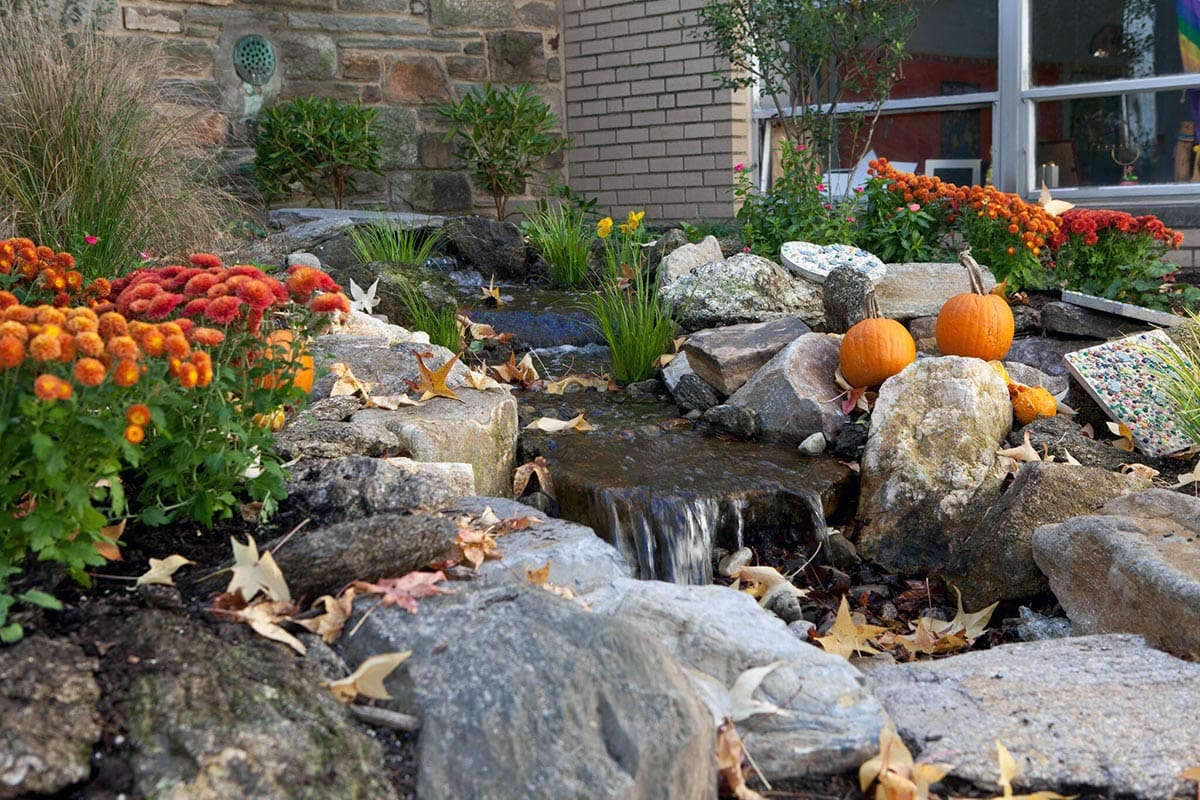
A fall pond shutdown is the visit that decides how your spring goes. Done properly, the pond sits quietly under the ice for four months and wakes up in March looking more or less the way it did in October. Skipped, you spend April dealing with black water, a dead pump, and sometimes fewer fish than you had in November.
Here is what a shutdown actually involves and how to tell whether yours needs one.
What gets done
The debris comes out. Leaves, sludge, and anything that has settled on the bottom over the season. This is the bulk of the work and it is the part that matters most, because every bit of organic matter left in the pond spends the winter decomposing, burning oxygen and producing gases that have nowhere to go once the surface seals over.
The skimmer and filter get cleaned. Nets emptied, media rinsed, anything that has packed up over the season cleared out.
The pump comes out and gets stored properly. Unplugged, pulled, and kept somewhere frost free, submerged in a bucket of water so the seals stay wet. Pumps that dry out over the winter crack, and you find out in April.
Plants get cut back. Dead and dying material trimmed, tropicals pulled, the rest left at a length that will not add to the debris load.
Aeration goes in. A bubbler set on the second shelf so it breaks the surface, which oxygenates the water and keeps a hole open in the ice for gas exchange. On ponds that need it, a floating de-icer as well.
Netting goes over the pond if you are on the leading edge of leaf drop and there are trees overhead. Netting before the leaves come down is much less work than pulling them out after.
Shutdown or keep it running
Not every pond gets shut down. Some of our customers run their waterfalls straight through the winter because the ice formations are the best thing the pond does all year, and we are happy to set that up.
That choice comes with obligations. You have to watch for ice dams diverting water out of the basin, and you have to keep the pond topped off at a time when your outdoor spigots are shut off. If that sounds like more than you want to think about in January, a shutdown is the right call. We walk through how we decide in should you run your waterfall all winter.
When to schedule it
After the bulk of the leaves are down, before the first hard freeze. In the Greater Philadelphia area that window is usually late October into November, and it is narrow.
The practical problem is that everybody needs it in the same three weeks. Our fall schedule fills, and the ponds that get cleaned in early December are the ones whose owners called in September.
What it costs
Fall netting and winter prep is one package: we install netting in fall, then remove it and handle winter prep. It starts at $175, with medium ponds at $200 to $275 and large ponds at $275 to $400. Spring pond cleaning starts at $450, with small ponds at $850 to $1,000, medium ponds at $1,000 to $1,350, and large ponds at $1,350+. Full pricing is on our pricing page.
Doing it yourself
Plenty of pond owners handle their own shutdown, and there is nothing wrong with that. The full walkthrough is in our complete guide to winter pond care in Philadelphia. The three things you cannot skip are getting the debris out, stopping feeding once the water hits 50 degrees, and keeping a hole open in the ice all winter.
Where people get into trouble is underestimating the debris removal and discovering in February that the pond sealed over with a winter worth of leaf litter underneath it.
Get on the fall schedule
We do fall cleanouts, netting and winter prep across Bucks, Montgomery, Chester and Delaware Counties, Philadelphia, and South Jersey, on ponds we built and ponds we did not. Contact us and we will get you scheduled before the freeze.