
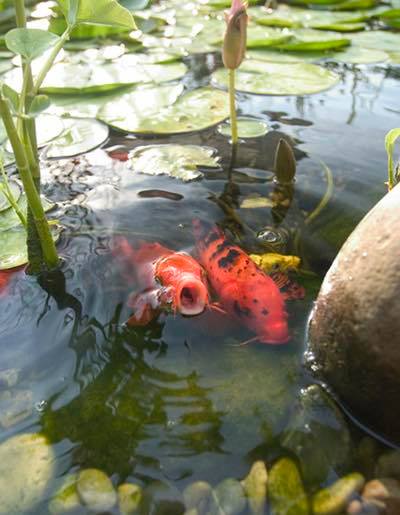
Feeding time is the best part of owning koi for a lot of people. The fish come right up to the edge, some learn to eat out of your hand, and the kids never get tired of it.
It's also where most koi problems start.
Not because people feed the wrong brand. Because they feed at the wrong time, or they feed too much. Koi don't really have an "I'm full" switch, and what they don't eat ends up as pollution your filter has to deal with. So here's how we tell our own customers to do it.
Rule one: feed the water temperature, not the calendar
Koi are cold-blooded. Their digestion runs entirely on water temperature, not the air temperature on your phone. A sunny 65-degree afternoon in March means almost nothing if the water down where the fish are sitting is still in the 40s.
So the first thing you need isn't food. It's a pond thermometer you can drop to mid-depth.
Here's the schedule we use:
| Water temperature | What to feed | How often |
|---|---|---|
| Below 50°F | Nothing | Don't feed. They're slow, not starving. |
| 50 to 55°F | Wheat germ cold-water food | A small amount every 2 to 3 days |
| 55 to 65°F | Wheat germ or a light all-season food | Once a day, small portions |
| 65 to 80°F | Quality growth food, higher protein | 1 to 3 small feedings a day |
| Above about 85°F | Back off to a light food | Less often, smaller portions |
Below about 50 degrees a koi basically can't digest. Food goes in, sits there, and spoils inside the fish. That's the whole tragedy of winter and early spring feeding in one sentence.
And at the hot end, warm water holds less oxygen, and digesting a big meal uses more of it. That's why heavy feeding during a heat wave is risky.
How much to feed
Feed what your fish will eat in about five minutes, then stop. If food is still floating after that, or you find it collecting in the skimmer, you fed too much.
Watch how they eat. If they come up hungry and clean it up, you're in the right range. If they ignore it, they're telling you the water is too cold, too warm, or they're just not hungry. Take the hint.
A healthy young koi in summer grows roughly a half inch to an inch a month. If yours are growing and active, you're feeding enough.
Planted ponds need less
A well-balanced ecosystem pond with plenty of aquatic plants, a little algae and bugs is full of natural food. Koi in those ponds can get by on very little from you, and some owners only feed a couple of times a week, mostly for the fun of it. Ponds without much planting rely more on you, so daily feeding in the warm months makes sense there.
Feeding consistently in summer has a side benefit, too. Well-fed koi are less likely to tear up your water lilies. (If they're already doing it, see how to keep koi from eating your pond plants.)
Spring: the season people get wrong
Every spring we get the same message: "It hit 65 today, can I finally feed my koi?"
Please wait. More koi are lost to eager spring feeding than to the whole winter before it.
Start only when the water, not the air, is holding around 50 to 55 degrees. Begin with a wheat germ food in tiny amounts every couple of days, and step up as the water warms and stays warm. One warm day doesn't count. Wait for it to hold.
There's also a step that comes before the first pellet: the pond needs a proper opening. Leaves and muck left over from winter release ammonia as the water warms, and the biological filter takes weeks to wake back up. Feeding heavily into that stacks stress on stress. Clean, test, then feed, in that order. Our spring pond opening do's and don'ts walks through it.
Summer: grow them, don't flood them
Once the water is reliably above 65 degrees, this is growing season. A higher-protein growth food, a few small feedings a day, the five-minute rule. Keep an eye on oxygen during heat waves and cut back when the water gets very warm.
Fall: step it back down
As the water cools below about 60 degrees, switch back to wheat germ and feed less often. Once the water drops to 50, stop completely for the winter. Koi build up reserves through the summer and fall, and those carry them through the cold months.
It feels wrong to stop. It's the right call. Our winterizing guide covers the rest of the fall checklist.
Winter: no food
Water below 50 degrees means no feeding at all, even on a mild January day when the fish look like they're begging. They aren't starving. They're just slow. Keep a hole open in the ice and leave them be.
What makes a good koi food
Read the label the way you'd read your own food. A good koi food has:
- Fish meal or another quality protein near the top of the ingredient list
- Wheat germ in the cold-water and transition formulas, because it's easier to digest
- Vitamins and minerals, including stabilized vitamin C
- A pellet size that fits your fish, floating so you can see what gets eaten
Cheap food is a false economy. More of it passes through as waste, and that waste feeds algae and clouds the water.
Treats
Koi love the occasional treat. Watermelon, orange slices, shelled peas and lettuce are all fine in small amounts. Just remember everything you put in the pond either gets eaten or gets processed by your filter. Treats are a garnish, not a meal.
The biggest mistakes we see
- Feeding in cold water. The number one cause of spring losses.
- Overfeeding. The number one cause of green or cloudy water in a koi pond.
- Cheap food. More waste, slower growth, worse water.
- Feeding before the spring cleanout. The filter isn't ready for the load yet.
- Feeding heavily in a heat wave. Less oxygen, more demand for it.
Get the timing and the amount right and your koi will grow, color up and live a long time. Feeding is one of the big pieces in how long koi live.
If you'd rather not stand at the pond every morning second-guessing the thermometer, that's what our maintenance packages are for. We open the pond, get the filter going, test the water and tell you when it's safe to start feeding. Start a Conversation or call 215-880-6811.