
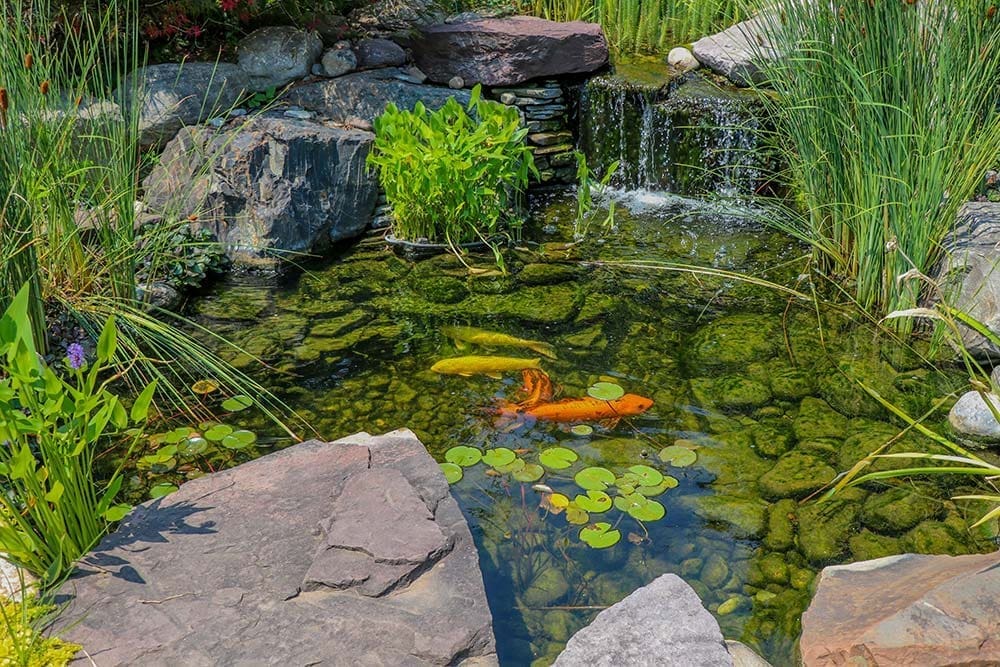
"How long will my koi live?"
We hear that question at almost every new koi pond we build, and the honest answer usually surprises people. A koi that's well cared for in a good backyard pond will commonly live 25 to 35 years. High-quality Japanese koi in excellent water often go longer, and plenty of hobbyists have fish pushing 40 or 50.
Your fish won't outlive your grandchildren. But there's no reason it shouldn't outlive your mortgage.
And the flip side is just as true. Koi in a neglected pond often only make it 3 to 5 years. Same fish, same species. The difference is almost always the pond.
The short answer, by type of koi
- Domestic koi (bred outside Japan, the kind most garden centers and many breeders sell): typically 15 to 25 years, often more in a well-run pond.
- Japanese-bred koi: commonly 25 to 35 years, with long-lived individuals reaching 40 to 50.
- Butterfly koi (the long-finned variety): about the same as standard koi when they're kept well. We cover them in butterfly koi facts every pond owner should know.
Those are averages, not guarantees. A koi's genetics set the ceiling. Its pond decides how close it gets.
What about the 226-year-old koi?
You've probably seen the story. A scarlet koi named Hanako was reported to be 226 years old when she died in Japan in 1977. Her age was estimated by counting the growth rings on one of her scales, the same way you'd count rings on a tree stump.
Some experts question how precise that count was. Either way, Hanako is the extreme outlier. Use her as a fun fact, not a target. A realistic goal for a backyard koi is several decades, and that's still a long-term commitment worth thinking about before you buy fish.
How to tell how old a koi is
Koi scales lay down growth rings, called circuli, a little like tree rings. Under magnification, a single scale can give an estimate of age. For most pond owners, though, size and history are the practical clues. A koi grows fastest in its first few years, so a 20-inch fish is not a young fish.
What actually decides how long your koi live
Water quality, above everything else
Koi are big, hungry fish that produce a lot of waste. The invisible stuff, ammonia and nitrite, is what quietly shortens their lives. You can't see it and you can't smell it, and it's the first thing we test when a fish looks off.
The single biggest predictor of a long life is filtration that's actually sized for the fish load and keeps the water stable all year. Our guide to how pond filtration works explains the pieces, and what your water test results mean shows what we look for.
Depth
In the Philadelphia area, koi need water deep enough to stay liquid at the bottom through a hard January and cool enough to get through a hot July. We like three feet or more for koi. Shallow ponds cook fish in summer and stress them in winter, and every stress event takes something off the end of a life. More on that in how deep a koi pond should be.
Oxygen
A waterfall, stream or aerator keeps dissolved oxygen up. Warm water holds less oxygen than cold water, which is why so many fish are lost on hot summer nights. Keeping fish safe in the heat comes down to circulation, shade and not overfeeding.
Food
Good food, matched to the water temperature, in sensible amounts. Cheap food and overfeeding pollute the water faster than they feed the fish. Feeding in water that's too cold is just as harmful, because koi can't digest properly below about 50 degrees. Our koi feeding guide lays out what to feed and when, season by season.
Winter care
Koi don't hibernate in the true sense, but they slow way down. They need an opening in the ice for gas exchange and no food once the water is cold. Most of the winter losses we see come from a frozen-over pond, a shallow pond, or someone feeding too late in the fall. See how to winterize your koi pond.
Predators
A heron can end a ten-year-old koi in seconds. Depth, a deep hiding spot like a fish cave and a smart layout matter more than any gadget. We cover the details in protecting koi from herons, raccoons and mink.
Room to grow
Koi grow big, often 2 to 3 feet. Overcrowding means more waste per gallon, more competition and more stress. If you're planning a new pond, plan for full-grown fish, not the 4-inch ones you bring home.
Why so many backyard koi die young
In our years working on ponds around Bucks, Montgomery, Chester and Delaware counties, the same short list keeps coming up:
- Filtration that was undersized from day one
- A pond built too shallow
- A heron with an easy target
- A spring opening that went sideways, usually from feeding too early
- A cleanout that got skipped until the water turned against the fish
None of that is bad luck. All of it is preventable.
The boring secret to old koi
Long koi lifespans are boring on purpose. Deep enough water. More filtration than you think you need. Steady oxygen. Protection from predators. The right food at the right temperature. And somebody checking the water on a schedule, so small problems get caught at a routine test instead of showing up as a sick fish.
Do that, and 30-plus years is an ordinary outcome, not a miracle.
That routine is exactly what our maintenance packages and seasonal service are built around. And if you're starting from scratch, our koi pond design and installation page shows how we build ponds meant to grow old fish.
Want an honest read on whether your pond is set up for long-lived koi? Start a Conversation or call 215-880-6811.