
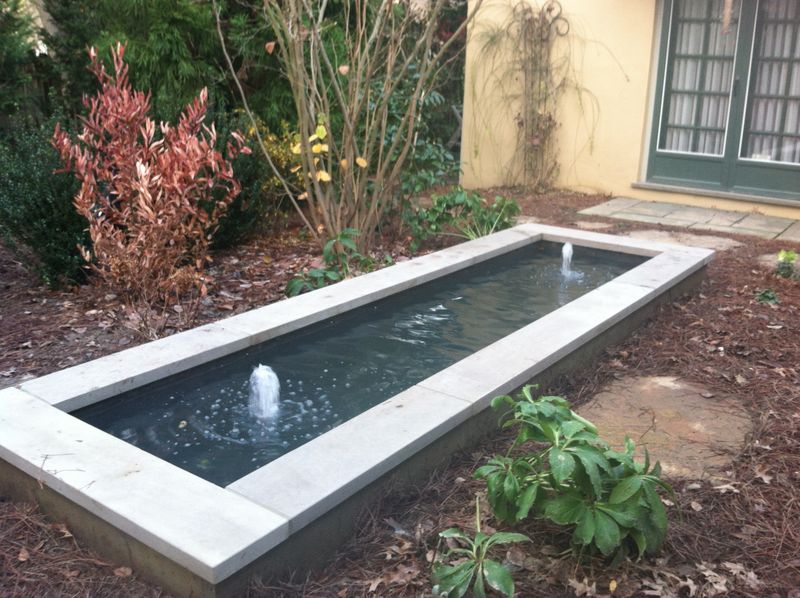
Here's something most people don't think about until it's too late: a formal pond and a naturalistic pond handle ice in completely different ways.
A backyard ecosystem pond has sloped, rocky sides. When the surface freezes and the ice expands, it rides up those slopes and mostly takes care of itself.
A formal pond has straight walls. Sometimes they're vertical, sometimes they're stone or brick, and sometimes the whole thing sits up above the patio. When ice forms in a box like that, it has nowhere to go but sideways. Into your walls. Into your coping. Into that beautiful bluestone cap you picked out.
So if you have a formal pond, or you're thinking about one, this is the post for you.
What ice actually does to a formal pond
Water expands as it freezes. In an open, sloped pond, that's no big deal. In a rectangle with rigid sides, a solid sheet of ice pushes outward against every wall at once. Then it thaws a bit during a sunny afternoon, refreezes overnight, and pushes again.
Around Philadelphia, we can get that cycle over and over from December into March. Each round is a small shove. Over a few winters, that's how you end up with:
- Coping stones that have lifted or shifted out of line
- Cracked mortar joints, especially at the corners
- Water getting behind the wall facing and popping stone veneer loose
- A liner that's been pulled or stressed where it's tucked under the cap
None of this happens in a single night. It's slow. Which is exactly why people miss it until spring.
Raised ponds get it worse
A raised formal pond is gorgeous on a patio. Water at sitting height, a wide cap you can perch on, fish right at eye level. We love building them.
But think about where that water is sitting. In an in-ground pond, the earth around the walls acts like insulation. In a raised pond, the walls are out in the open air. Cold comes in from the sides as well as the top, so a raised pond freezes faster and deeper than an in-ground pond of the same size.
That matters for the structure, and it matters a lot if there are fish in it. More on that in a minute.
How we protect a formal pond through the winter
There's no single trick. It's a few habits that add up.
Keep a hole in the ice. An opening in the surface relieves some of the pressure and lets gases escape, which your fish need anyway. A floating de-icer or a small aerator does the job. For koi ponds, this isn't optional. We explain why in the benefits of a winter pond aerator.
Shut down the spillways and water walls. Sheet waterfalls and spillway lips are the first things to ice up. Once ice starts building on the lip, water gets thrown where it shouldn't go, the level drops, and the pump can run dry. For most formal ponds, we turn those features off for the season and let a de-icer handle the surface.
Drop the level a little on decorative ponds. If your formal pond has no fish, lowering the water a few inches below the coping keeps ice from bonding to the underside of the cap and lifting it. Don't do this with fish in the pond unless you have depth to spare.
Clean it before it freezes. Leaves that sink in November rot on the bottom all winter. In a formal pond, there's usually no gravel to hide that mess, and come spring you'll see every bit of it. A fall cleanout is a lot easier than an April one.
Check your joints in the fall. Open mortar joints and gaps under the coping let water in, and water in a crack is a crack that grows. Repointing a joint in October is cheap. Resetting a wall in May is not.
What about fish in a formal pond?
Fish can absolutely winter in a formal pond. They just need room to get below the cold.
Our general rule for koi in this climate is three feet of water or more, with an opening in the ice all winter. In a raised pond, we like to sink part of that depth below the patio so the fish have ground temperature working in their favor. A pond that's only 24 inches deep and sitting entirely above grade is a tough place for a koi to spend January.
If your pond is shallow, it's worth a conversation about moving fish indoors for the winter, or about rebuilding the pond with a deeper section. Our koi pond winterizing guide covers the rest of the fish side.
Building it right from the start
The best winter protection is designed in before the first block goes down. When we build a formal pond, we think about:
- Footings that go below the frost line, so the walls don't heave
- A rubber liner system inside the masonry, so the stone is the look and the liner holds the water
- Coping that's set and sealed so water runs off the top instead of soaking in
- Enough depth below grade for fish, if fish are in the plan
- An easy way to run a de-icer, with power right where you need it
When a formal pond starts having problems, it often traces back to one of those being skipped. A wall without a proper footing, or a pond that was really built as a shallow reflecting pool and then had koi added later. (We once renovated a 25 by 60 foot formal pond at the Penn Museum that started life exactly that way. You can read how we turned it around.)
If your formal pond already has winter damage
Lifted coping, cracked corners and loose veneer can almost always be fixed. Usually that means resetting the cap, repointing joints and checking that the liner behind it is still doing its job. Spring is the best time for masonry work, but it's smart to get it looked at before the next freeze makes it worse.
Our seasonal maintenance visits include fall shutdowns and spring openings for formal ponds all over Bucks, Montgomery, Chester and Delaware counties, and we'll flag anything that looks like it's starting to move.
Got a formal pond and want a second set of eyes before the cold settles in? Start a Conversation or call 215-880-6811.