
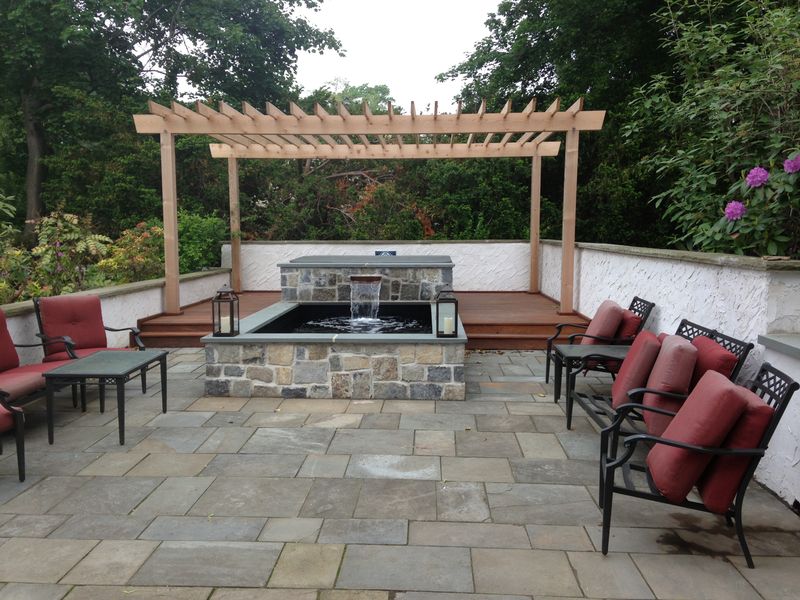
There's a moment that happens almost every time we finish a raised pond. The homeowner sits down on the wall, looks into the water, and a fish swims right up to them.
That's the whole pitch, really.
A raised formal pond brings the water up to you instead of making you walk out to it. It turns a pond from something you look at across the yard into something you sit beside with your coffee. And on a patio, it does it without eating up the whole space.
Here's what to know if you're considering one.
What makes a pond "raised"
Simple. Instead of the water sitting at ground level, part or all of the pond is built up above it, with walls of stone, brick or block faced in natural stone, and a wide cap (the coping) on top.
Most of the raised ponds we build land somewhere around seat height, which is the sweet spot. High enough to sit on comfortably, low enough that it still feels like part of the patio rather than a wall dividing it. Some are taller, especially when they're built against a house wall or a slope. Some are only a course or two above grade, just enough to give the edge some presence.
Why people love them
You can actually sit on it. A wide coping turns the pond into extra seating for a party. People gravitate to it.
Fish at eye level. Koi learn quickly who brings the food. In a raised pond, they come right up to the edge where you're sitting. Kids love it. So do the adults, honestly.
It fits tight spaces. A raised pond works beautifully on a patio, a terrace, a courtyard or a city lot where there's no room for a sprawling naturalistic pond. We've tucked them into corners of patios that would otherwise just hold a planter.
Easier on the knees. Feeding fish, trimming plants and skimming leaves is a lot more pleasant when you're not kneeling on wet stone to do it. For anyone with a bad back, or who wants to keep enjoying a pond well into retirement, that matters.
A clear edge. A raised wall makes it obvious where the patio ends and the water begins. Nobody wanders into it in the dark. It's not a substitute for supervision around little kids, but it's a meaningful difference from a pond that sits flush with the ground.
How we build one
This is where formal ponds are different from what most people picture when they think "pond." There's real masonry involved, and the details that matter are mostly underground.
Footings below the frost line. In our part of Pennsylvania, frost can reach roughly 30 to 36 inches down. A wall that isn't sitting on a proper footing below that will heave and crack as the ground freezes and thaws. It's one of the most common problems we see on raised ponds.
A liner inside the walls. The stone is the look. The water is held by a rubber liner system inside the masonry, with protective underlayment. Stone and mortar alone will eventually seep. A liner doesn't care.
Depth below grade. Even though the pond is raised, we usually dig part of it into the ground. That gives fish a deeper, cooler spot in summer and a safer place to ride out winter, since the earth around the bottom holds temperature far better than a wall standing out in the cold. For koi in this climate, we like three feet of water or more.
Hidden equipment. Skimmers can be built into the wall, and filters, pumps and plumbing get tucked behind or beside the pond, so all you see is stone and water.
Coping that sheds water. The cap is set so rain runs off the top instead of soaking in, and so it overhangs the wall slightly. It's a small detail that makes a huge difference over twenty winters.
Choosing your materials
The fun part. The wall and cap should talk to what's already there.
- Bluestone coping is the classic choice around here, and it pairs with almost any flagstone patio.
- Brick looks right at home next to a brick colonial or a city rowhouse.
- Natural stone veneer on the walls gives a raised pond a warmer, more rustic feel, even with formal lines.
- Travertine or cut stone suits more contemporary homes.
Whatever you choose, it has to handle freeze and thaw. Some beautiful materials don't love Pennsylvania winters. We'll steer you toward what lasts.
Add-ons that make a raised pond sing
A raised pond is a great stage for a few extras. A spillway or sheet waterfall coming off a back wall. A bubbling jet in the middle. Underwater lighting so the fish and the wall glow after dark (that's where our pond lighting work comes in). A pergola overhead. Years ago we built a 10 by 6 foot formal pond with a cedar pergola as part of a full patio makeover, and the client was thrilled with how it turned out. You can see the before and after here.
The one thing to plan for: winter
Raised ponds are more exposed to cold than in-ground ponds, because the walls are out in the open air. That means ice pushes on the walls, and the water freezes faster and deeper. It's very manageable with the right design and a few winter habits, and we walk through all of it in what ice does to a formal pond.
Is a raised pond right for you?
If you've got a patio you love, a house with some architecture to it, and you want water you can sit next to, it's hard to beat. If your yard is more woodland garden than terrace, a naturalistic pond may suit you better, and we lay out the trade-offs in formal vs. naturalistic ponds.
We design and build formal ponds, raised and in-ground, across Bucks, Montgomery, Chester and Delaware counties, Philadelphia and South Jersey. Winter is actually a great time to plan one, so it's designed and ready to build when the ground thaws.
Start a Conversation or call 215-880-6811. Tell us about your patio. We'll tell you what's possible.