
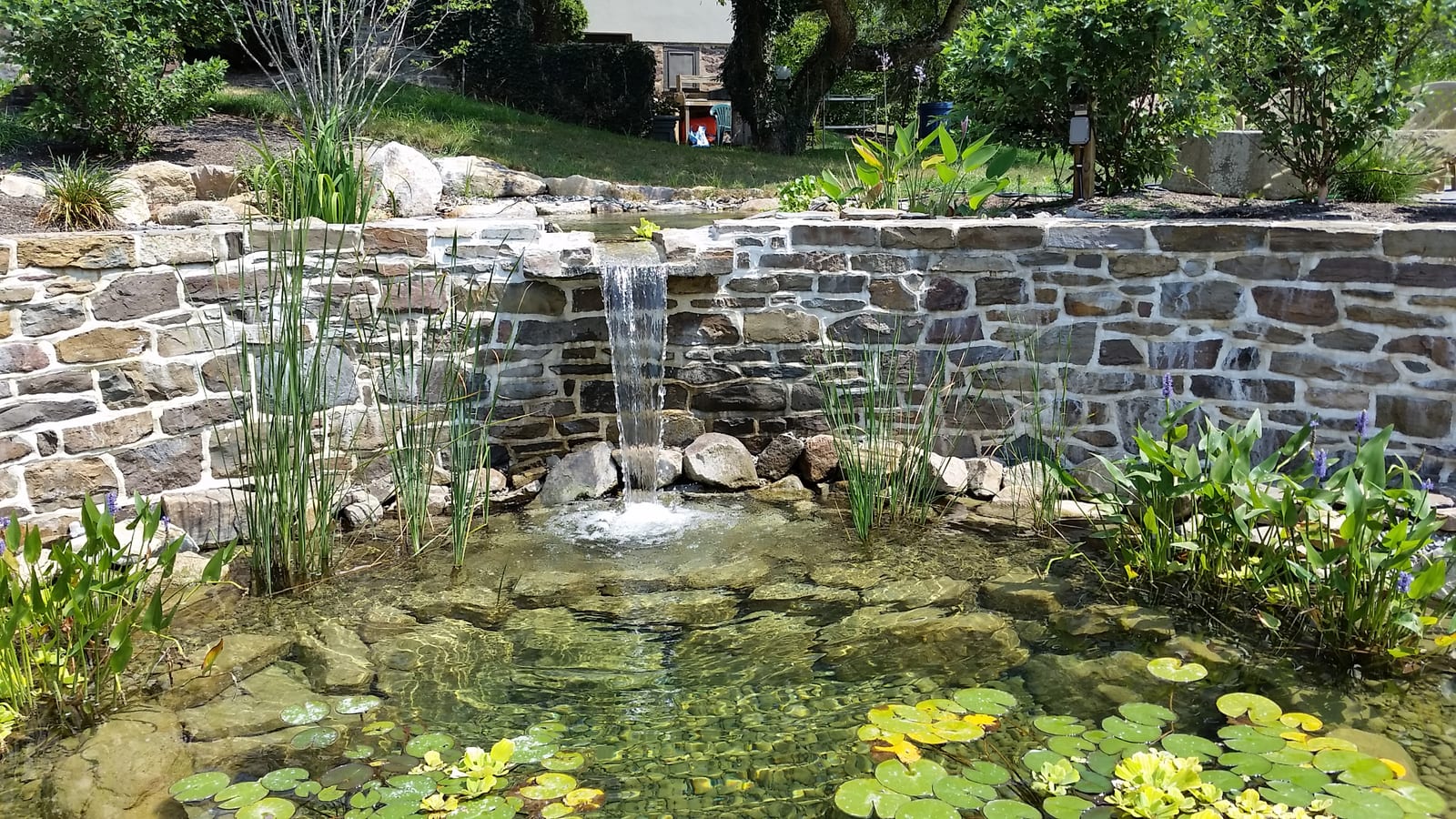
"Do you build the natural-looking ones or the fancy rectangular ones?"
Both. And we get asked which one is better about once a week.
The honest answer is that neither is better. They're different tools for different houses, different yards and, to be blunt, different personalities. So instead of a sales pitch for either, here's how we actually help people decide.
First, what we mean by each
A naturalistic pond (we usually call it an ecosystem pond) is built to look like it was always there. Irregular shape. Boulders around the edge. Gravel on the bottom. Plants spilling over the sides. Often a stream and waterfall feeding it. The goal is for you to forget a person built it.
A formal pond is the opposite. Geometry on purpose. Rectangles, squares, circles, long canals. Cut stone, brick or bluestone coping with a crisp edge. Still, reflective water, maybe a single fountain jet or a spillway. The edge isn't hidden. The edge is the design. We wrote more about the style itself in formal ponds: when clean lines and still water are the whole point.
Start with the house, not the pond
This is the question that settles it for most people.
Stand at your back door and look at what's already there. A stone colonial with a symmetrical terrace and boxwood hedges? A modern build with big glass and straight concrete lines? A city rowhome courtyard with brick on three sides? Those spaces are already formal. A pile of boulders dropped into the middle of them tends to look lost.
A wooded lot in Doylestown, a rambling garden in Media, a backyard that slopes down to a tree line? That's naturalistic country. A crisp rectangle out there can look like it got delivered to the wrong address.
Most of the time, the house has already made the decision. We just point it out.
How they differ once they're built
Maintenance. This one surprises people. An ecosystem pond has rocks and gravel on the bottom, and that surface area is home to a huge population of beneficial bacteria that quietly eat waste and keep the water balanced. A formal pond usually has a bare, clean bottom so the lines stay sharp. That looks amazing, but there's nowhere to hide debris and less natural surface for bacteria to live. Formal ponds lean harder on good filtration and regular cleaning to stay crystal clear. Not harder to own, just different.
Fish. Both can hold koi and goldfish. The catch with formal ponds is depth and heat. A shallow formal pool in full sun warms up fast in July, and warm water holds less oxygen. When we renovated the 25 by 60 foot pond at the Penn Museum, a big part of the problem was that it had been built as a shallow reflecting pool and then asked to be a fish pond. Different jobs. You can read that whole story here.
Wildlife. Frogs, dragonflies and birds love the sloped, planted edges of an ecosystem pond. A formal pond with vertical walls is less of a wildlife magnet. Some people see that as a downside. Some see it as a feature.
Sound. Naturalistic ponds usually come with a waterfall or stream, so there's plenty of sound. Formal ponds are quieter by nature, and the sound you get is more refined: a spillway, a sheet of water off a wall, a bubbling jet. If you want that big rushing waterfall sound, that's a point for the ecosystem side.
Winter. Sloped, rocky sides let ice expand upward without much drama. The straight walls of a formal pond take the full push of the ice. It's very manageable, but it's a real design consideration, and we cover it in what ice does to a formal pond.
Cost. We're not going to throw out a number without seeing your yard. What we can tell you is what drives the price. On a naturalistic pond, it's mostly size, boulders and how much stream and waterfall you want. On a formal pond, it's the masonry: wall height, the stone you choose for the coping and facing, and the precision work it takes to get everything dead level. A raised formal pond with natural stone veneer is a different project from a simple in-ground rectangle with a bluestone cap. Our instant estimate tool is a good place to get a ballpark for the size you have in mind.
The middle ground nobody talks about
You don't have to pick a side.
Some of our favorite projects are hybrids. A straight stone wall on the patio side with a sheet waterfall spilling into a pond that softens into plants and rock on the garden side. A formal pool near the house that feeds a natural stream heading out into the yard. The formal piece ties the water to the architecture, and the natural piece ties it to the landscape.
If you're torn, that's usually a sign a hybrid is worth sketching out.
A few questions to ask yourself
- When you picture sitting by the water, are you on a patio or out in the garden?
- Do you want fish, and are they the main event or a bonus?
- Is the space more courtyard or more backyard?
- Do you love the sound of a waterfall, or would you rather have calm, still water?
- Does a little "wildness" (frogs, plants spilling over, the occasional leaf) make you happy or make you twitch?
There are no wrong answers. But your answers will point pretty clearly in one direction.
Let's figure it out together
We've been building both styles across Greater Philadelphia and South Jersey for over 25 years, from tiny courtyard pools in the city to estate ponds on the Main Line. Take a look at our formal pond and koi and ecosystem pond pages to see the range.
Or skip the homework. Start a Conversation or call 215-880-6811, tell us about your house and how you want to use the space, and we'll tell you honestly which way we'd go.