
How Your Pond Actually Stays Clean
Every pond owner eventually asks some version of the same question: where does the dirt go? Fish eat and produce waste. Leaves blow in. Pollen lands on the surface every spring. And yet a well built pond stays clear for months at a time without anyone scrubbing it.
The answer is filtration, but not the kind most people picture. There is no single box doing all the work. In the ecosystem ponds we build around Greater Philadelphia, cleaning happens in several places at once, and each piece handles a different kind of mess. When you understand what each part does, it gets much easier to tell when something is off and why.
Here is how it all fits together.
The Skimmer: Catching Debris Before It Sinks
The skimmer sits at the edge of the pond, usually opposite the waterfall. It pulls water off the surface, which is where most debris floats before it sinks: leaves, seeds, pollen, the occasional drowned bug.
Inside the skimmer there are two layers of protection. A net or basket catches the big stuff. Behind it, filter mats catch the finer particles. The pump also lives inside the skimmer, protected from the debris it would otherwise suck up.
The skimmer is your mechanical filter. It does not break anything down. It just holds onto debris until someone empties it. That is why it is the single most important thing to check during the fall. A skimmer basket full of oak leaves restricts flow to the pump, the waterfall slows down, and the whole system starts working against itself. This is also the reason we push fall netting so hard. Every leaf the net stops is a leaf the skimmer never has to deal with.
The Biofalls: Where the Real Cleaning Happens
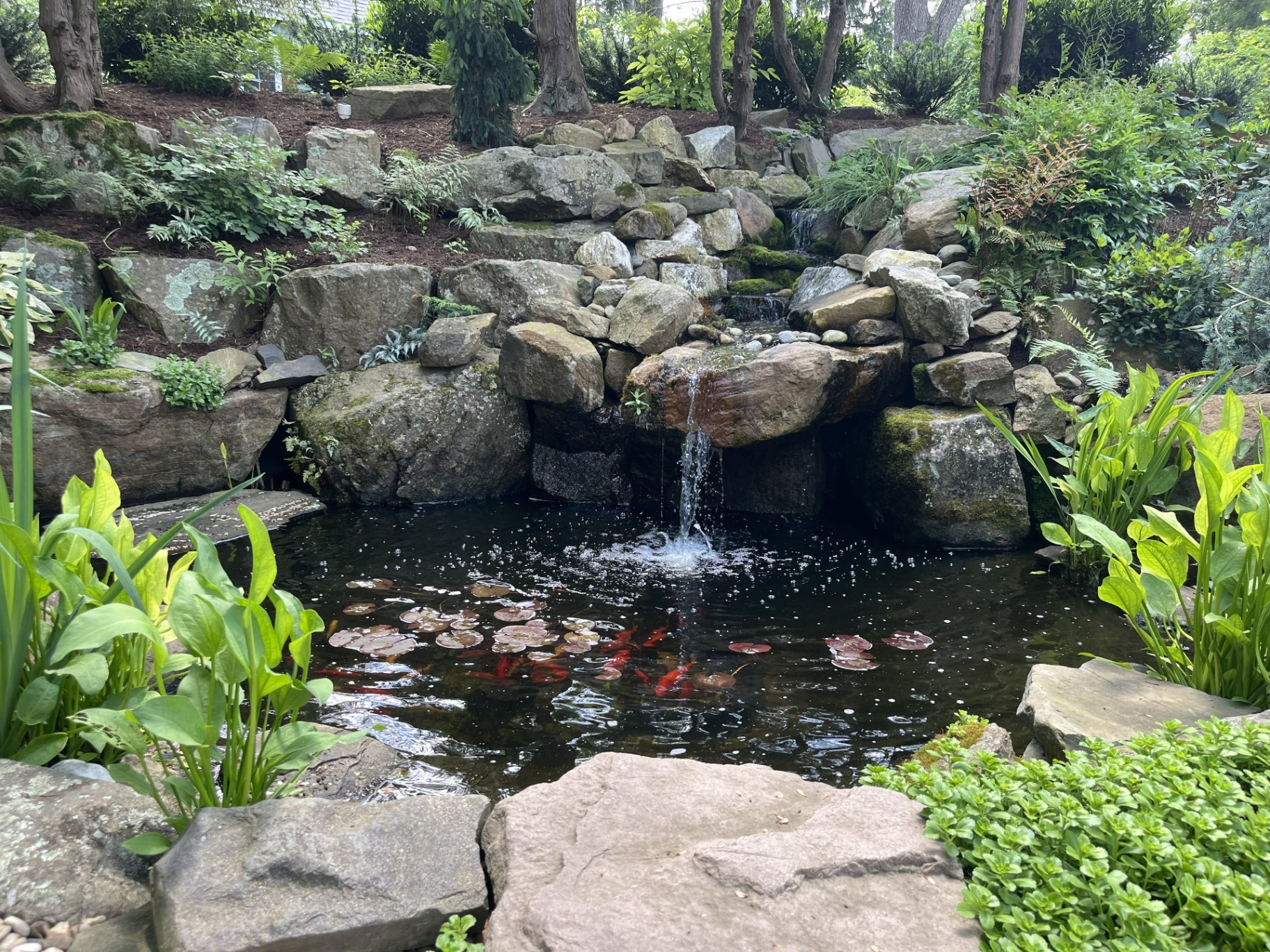
From the skimmer, the pump pushes water through a pipe to the top of the waterfall. Hidden at the top is a filter box we call the biofalls. Water flows up through it and spills out over the stones as your waterfall.
Inside the biofalls are more filter mats and a large volume of biological media. This is where the important work happens. Fish waste produces ammonia, which is toxic to fish even at low levels. Beneficial bacteria living on the media convert that ammonia into nitrite, and then into nitrate, which is far less harmful and which plants happily absorb.
That is biological filtration, and it is the reason a pond with a working ecosystem can support a healthy population of koi without the water turning toxic. The biofalls gives those bacteria a protected place to live and a steady supply of oxygen rich water flowing past them.
The waterfall itself helps too. Water tumbling over rock picks up oxygen, which the fish need and which the bacteria need to keep working.
The Rocks and Gravel: The Filter You Do Not See
Most people think of the rock and gravel lining a pond as decoration. It is actually one of the biggest parts of the filtration system.
Every stone in the pond is covered in the same beneficial bacteria that live in the biofalls. Add up all the surface area of the rock and gravel across the floor and walls of a pond, and it dwarfs anything you could fit in a filter box. The bacteria living there break down fish waste and organic matter right where it settles.
This is one of the main differences between an ecosystem pond and a bare liner pond. A bare liner gives bacteria almost nowhere to live, so all the biological work has to happen in a filter, and anything that settles on the bottom just sits there and rots. If you have ever seen a pond with a black, mucky floor, that is usually what is going on.
Plants: Competing With Algae for Food
Once bacteria have converted fish waste into nitrate, something has to use it up. If nothing does, algae will.
Aquatic plants are the answer. Water lilies, marginal plants along the shelves, and plants rooted in the gravel all pull nitrate and phosphate out of the water to grow. Every bit of nutrient a plant uses is a bit that algae cannot. Lily pads also shade the water, which slows algae growth and keeps the pond cooler in July.
This is why a pond with plenty of plants tends to stay clearer than a pond with very few. It is also why the first few weeks of a new pond can look a little green. The plants are still getting established, and the bacteria colonies are still building. We cover more of that in why your pond has algae and what to do about it.
Wetland Filters: Plants Doing the Heavy Lifting
On some ponds we add a wetland filter, sometimes called a bog filter. Instead of sending water straight into a biofalls box, the pump pushes it up through a bed of gravel planted with wetland plants. The gravel acts like a huge biological filter, and the plant roots pull nutrients out as the water passes through.
Wetland filters are especially useful on larger ponds, ponds with a lot of fish, or ponds that have fought algae for years. They also look like part of the landscape rather than a piece of equipment. You can see a couple of real examples in our wetland filter installation and wetland filter renovation projects.
Fish: Part of the System, Not Just Residents
Fish add waste to the pond, but they also help clean it. Koi and goldfish graze on algae and pick through the gravel, stirring up debris so it gets carried to the skimmer. A balanced fish population is part of a healthy ecosystem.
The key word is balanced. Too many fish produce more waste than the bacteria and plants can handle, and the water quality slips. If you are not sure whether your pond is overstocked, that is a good question to ask during a seasonal maintenance visit.
When Filtration Starts to Struggle
Most filtration problems we see come down to a handful of causes:
- A clogged skimmer. Full baskets and packed mats starve the pump. Check the basket weekly in fall, and more often after a windy day.
- Filter mats rinsed with tap water. Chlorine in tap water kills the beneficial bacteria. Rinse mats in a bucket of pond water instead.
- Too much cleaning, too often. A spotless biofalls has no bacteria in it. The goal is to remove the heavy debris, not sterilize the system.
- An undersized system. A pump or biofalls too small for the pond will never quite keep up, no matter how well it is maintained. This shows up often in ponds we are asked to renovate.
- Not enough plants. If the plants are sparse, algae has the nutrients all to itself.
- A mucky bottom. Years of buildup on the floor can overwhelm a system that is otherwise sound. That is what a full pond cleaning resets.
The Short Version
Your skimmer catches debris. Your biofalls and the rock across the floor of the pond host the bacteria that break down waste. Your plants use up the leftovers before algae can. When all of those pieces are sized correctly and working together, a pond mostly takes care of itself.
When one of them falls behind, the water usually tells you first: it slows, it clouds, or it turns green. If your pond is doing any of that and you cannot tell why, we have been diagnosing pond filtration problems across Greater Philadelphia for more than 25 years. Start a Conversation or call 215-880-6811 and we will help you figure out which piece needs attention.