
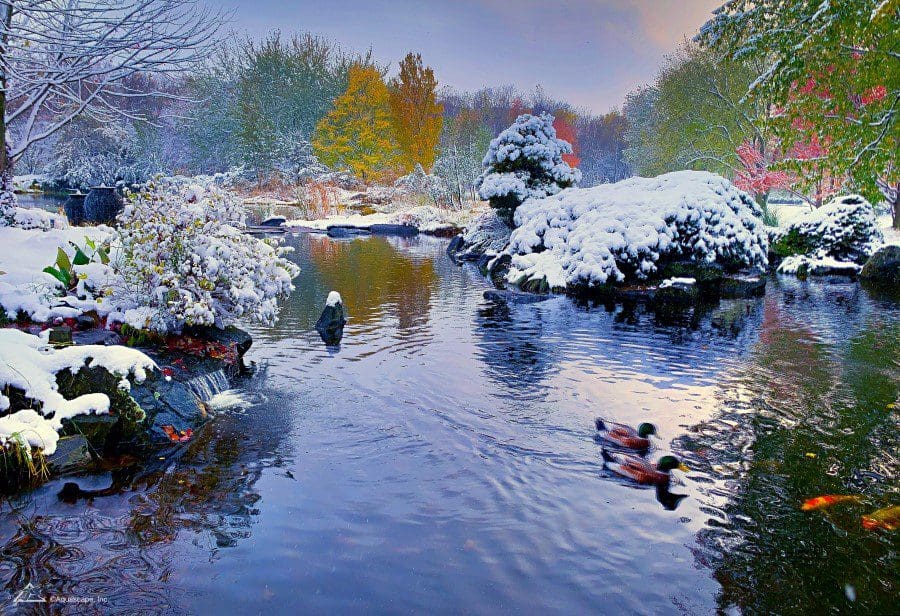
Every fall we get the same phone calls. The leaves are dropping, the water is getting cold, and somebody is standing at the edge of their pond wondering whether the fish are going to make it to April. The honest answer is that they almost certainly will, and that a Philadelphia winter asks very little of a pond that was built right. But the few things it does ask are not optional, and the mistakes are the kind that cost you a whole population of koi in one February night.
This is everything we tell our own customers, in the order it matters.
The short version
A pond in winter needs one thing: air. Not heat, not filtration, not food. Air.
As long as your pond is deep enough, the fish will settle to the bottom and go dormant. Their metabolism drops to almost nothing. They are built for this. What kills fish over the winter is not cold water, it is a pond that seals over completely, traps the gases from decaying leaves and fish waste underneath, and slowly poisons everything living in it.
So the whole job comes down to this: get the organic matter out before the freeze, stop feeding when the water hits 50 degrees, and keep a hole open in the ice all winter. Everything below is detail on those three things.
Clean the pond out before the freeze
This is the step people skip, and it is the one that makes the rest of winter easy or hard.
Every leaf left in the water breaks down. Decomposition consumes oxygen and releases the gases you are about to trap under the ice. A pond that goes into winter clean is a pond that needs almost no attention until spring. A pond that goes in full of leaf litter is the one that turns brown, goes anaerobic, and gives you a bad surprise.
During leaf drop, empty the skimmer net every day. It is tedious and there is no way around it. Net out what you can from the surface, and get the sunken leaves off the bottom. You do not have to be surgical about it. Leaving a few leaves gives frogs and insects somewhere to overwinter, which is fine. Leaving six inches of sludge is not.
While you are in there:
- Prune the yellowing leaves off your plants. Hardy and tropical lilies usually hold on until the first heavy frost.
- Stop fertilizing. Cutting off fertilizer tells the plants the season is ending.
- Cut back dead plant material once the plants have gone by, and pull the tropicals.
- Cattails can be cut above the water line, or left standing. They look genuinely good in the winter, so we usually leave them.
If the water has already gone brown on you, that is excess organic matter. Pull the debris out and add activated carbon to clear it.
This is what a fall pond cleanout and netting covers when we do it, and it is the single highest-value hour anybody spends on a pond all year.
Stop feeding at 50 degrees
When the water temperature drops to 50 degrees Fahrenheit, put the food away until spring. In the Philadelphia area that usually lands somewhere around Thanksgiving, but go by the thermometer, not the calendar.
Below 50 degrees a koi digestive system has essentially shut down. Food they cannot process sits in the gut and rots there, and whatever they do not eat rots in the water. Both outcomes are worse than a hungry fish, and the fish is not actually hungry. This is how koi are built to spend winter.
More on the full year of feeding in feeding your koi through a Philadelphia winter and spring.
Decide: shut it down, or run it through
There is no universally right answer here. It depends on your pond, your waterfall, and how much you want to look at it in January.
Shutting the pond down
Unplug the pump and pull it out of the water. Store it somewhere frost free, submerged in a bucket of water, so the seals do not dry out and crack over the winter. A dry-stored pump is a pump you replace in the spring.
Then add a bubbler. Set a small recirculating pump or an aerator on the second shelf of the pond so it breaks the surface. That bubbling does two jobs: it oxygenates the water, replacing what your waterfall used to do, and in all but the coldest stretches it keeps a hole open in the ice on its own.
If you do not have fish, none of the aeration matters. Shut it down and walk away.
Running through the winter
Ice formations on a running stream and waterfall are the best thing a pond does all year. If you want that, you can have it, but it is not a set-and-forget arrangement.
Two things will get you. The first is ice dams. Ice builds up in the stream and waterfall and diverts the flow out of the basin, and a pond can empty itself into the yard over a weekend. Check the falls and the water level regularly through the winter. If you see a dam forming or the level dropping fast, that is your signal to shut the pump down for the season.
The second is topping off. Outdoor spigots and automatic fill valves get shut down in the fall so the lines do not freeze and split, which means the usual water supply is gone exactly when you need it. Running a pond through winter means you need another source, usually a hose run from inside the house, and you need the pump to always have enough water to operate.
We walk through how we make this call, pond by pond, in should you run your waterfall all winter, and the running-pond specifics are in how to maintain a running winter pond.
Keep a hole in the ice
This is the one that actually matters for the fish.
A hole in the ice lets the gases produced by decaying organic matter and fish waste escape instead of accumulating under a sealed lid. Without it, the water under the ice becomes toxic. With it, your fish sleep through the winter and you see them again in March.
A bubbler handles this on its own most of the time. During long hard cold snaps it may not be enough, and that is when you add a floating de-icer. A de-icer is thermostat controlled: it only runs when the water is at or below freezing, warms the water just above that, and shuts off. It is not heating your pond and it will not run your electric bill up the way people assume.
If you run both, put the de-icer away from the bubbler. The current from the bubbler pushes the warmed water away from the de-icer and makes it cycle far more than it needs to.
More on sizing and choosing in the benefits of a winter pond aerator.
What not to do
Never break the ice with a hammer or anything else. The shockwave travels through the water and can kill or injure dormant fish. If the pond has sealed over and you need an opening, set a pot of hot water on the ice and let it melt through.
Do not poke extra holes around the waterfall. People see ice building up over the stream and start chipping at it. That ice sheet is insulation. It sits between the freezing air and the moving water underneath, and it is doing you a favor. Break it open in several places and you expose that running water to the cold all over again, which usually makes the icing worse, not better.
Do not pull your fish out. Assuming adequate depth, they are safer in the pond than anywhere you are likely to move them.
How deep does a pond need to be
At least 18 to 24 inches, and more is better. At that depth the pond will not freeze solid in a Greater Philadelphia winter, and the fish will hold at the bottom where the water stays just above freezing.
If your pond is shallower than that and you have fish in it, depth is the problem to solve, not aeration. A pond built too shallow to overwinter fish is one of the most common things we get called out to fix, usually on ponds somebody else built. That is a renovation conversation, and winter is a good time to have it.
What it costs
Fall netting and winter prep is one package that starts at $175, with medium ponds at $200 to $275 and large ponds at $275 to $400. Larger ponds sit at the top of that range. Spring pond cleaning starts at $450, with small ponds at $850 to $1,000, medium ponds at $1,000 to $1,350, and large ponds at $1,350+. Full numbers are on our pricing page.
Winter is when we book spring
Our calendar for spring cleanouts and next season installations fills up over the winter. If you already know you want work done in the spring, the time to get on the schedule is now, not in April when everybody else calls at once.
Fall is also the last practical window to get a feature built before the ground freezes, which is worth knowing if you have been thinking about it. More on that in why winter is a good time to start a pond project.
Questions we get every year
What does my fish pond actually need in the winter? Air, and that is close to the whole list. A way for harmful gases to leave the pond at all times. We recommend an aerator or bubbler. As long as the pond is at least 18 inches deep it will not freeze to the bottom and the fish will be fine.
When do I stop feeding? When the water temperature hits 50 degrees, usually around Thanksgiving here. Below that their bodies have already started shutting down and they cannot metabolize food.
Do I need to bring the fish inside? No. In a pond of adequate depth they are better off staying put.
My pond froze over completely. What do I do? Open a hole with hot water, not force. Set a pot of hot water on the ice and let it melt through, then get a bubbler or de-icer going so it stays open.
Can I leave the waterfall running? Yes, if you are willing to check on it. Watch for ice dams and keep the water level up. If you would rather not think about it until spring, shut it down and run a bubbler instead.
Will a de-icer run my electric bill up? Not the way people expect. It is thermostat controlled and only runs when the water is at or below freezing.
Want us to handle it
We do fall cleanouts, netting and winter prep across Bucks, Montgomery, Chester and Delaware Counties, Philadelphia, and South Jersey, on ponds we built and on ponds we did not. Get in touch and we will get you on the fall schedule.