
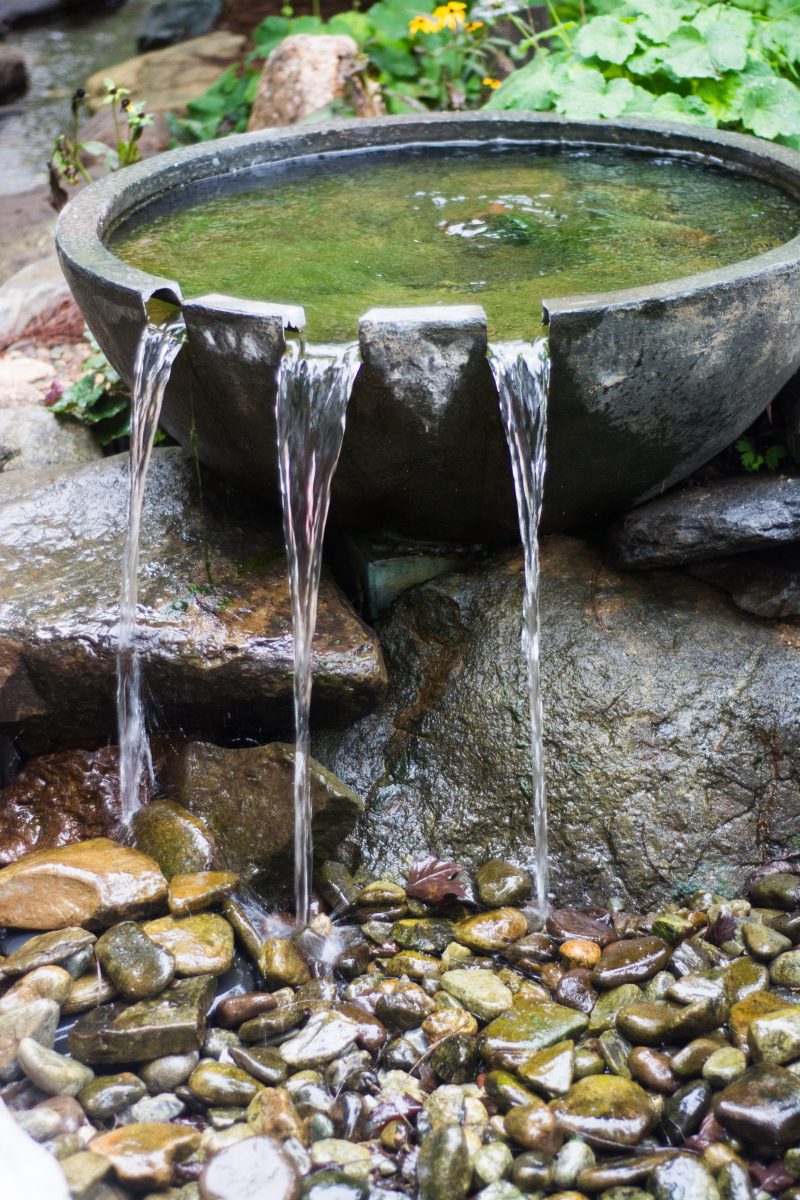
Stone does more work in a pond than most people realize. It decides how the pond looks, of course, but it also protects the liner, gives beneficial bacteria a place to live, anchors plants, and hides every bit of the structure so the water looks like it has always been there.
Choosing stone comes down to three questions: what kind of stone, what size goes where, and whether you want stone on the bottom at all. Here is how we answer each of those on the ponds we build and renovate around Greater Philadelphia.
The three stones we use most
None of these is better than the others. They give different looks, and the right one usually depends on your house, your landscape and the style of pond you want.
Mica stone
Mica stone is a regional stone, common throughout Philadelphia and Southeastern Pennsylvania. Its deep blue gray color blends naturally with the older stone homes and walls you see all over the Main Line, Chestnut Hill and Bucks County, and it has a slight silver shimmer that looks lovely under pond lighting at night.
Because it splits into flatter, layered pieces, mica stone works well for ledges, spillways and edges where you want a crisp, stacked look.
Pennsylvania field stone
Field stone comes in a wide range of shapes and sizes, which gives a lot of variety from a single type of rock. Many pieces arrive with lichens already growing on them, so a brand new pond can look aged and settled from the first day. The colors are muted, earthy browns, tans and grays that disappear into a planted landscape.
Field stone is our usual choice for a natural, woodland style pond or a waterfall that should look like it was always part of the hillside.
River rock
River rock is just what it sounds like: stone shaped by moving water rather than cut in a quarry. It runs from pea sized gravel up to boulders that weigh a ton or more, and it comes in blues, greens, reds, tans and grays, solid or striped.
What all river rock has in common is a smooth, rounded shape. That makes it the stone most people picture in a pond, and it is also why it is the safest choice anywhere stone sits directly on the liner. It suits both naturalistic ponds and calmer, Asian inspired designs.
Flagstone for crossings and seating edges
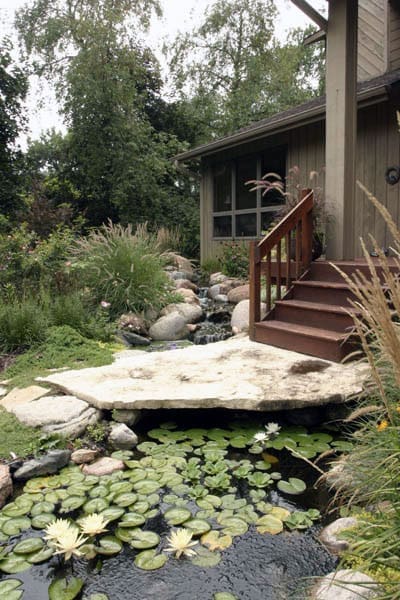
Flat flagstone is not usually the main stone in a pond, but it earns its place wherever people walk or sit. Stepping stones, bridges and a flat edge to sit on with your feet near the water all call for a broad, stable piece that will not rock. Our flagstone pond project shows how that looks in practice.
Should you put stone on the bottom of the pond?
This is the question we get asked most, and you will find people online arguing both sides. For the kind of naturalistic ecosystem ponds we build, our answer is yes, with the right size stone and the right maintenance plan.
Why we like stone and gravel on the bottom:
- It gives beneficial bacteria somewhere to live. Every rock and pebble adds surface area where the bacteria that break down fish waste and debris can grow. That works hand in hand with your filters, which we explain in how pond filtration works.
- It protects the liner. A layer of rock and gravel shields the liner from sunlight, from claws and paws, and from the occasional dropped tool. Covered liners last much longer, which we get into in how long a pond lasts.
- It gives plants a place to root and keeps soil from clouding the water.
- It looks natural. A bare liner bottom looks like what it is. A gravel bottom looks like a stream bed.
The honest tradeoff: debris settles between the stones, and over time that layer builds up. That is why ponds with gravel bottoms benefit from a full spring cleanout every year or so, where the stones are rinsed and the sludge comes out. A bare bottom is easier to vacuum, but it gives up the biological benefits above and leaves the liner exposed.
What size stone goes where
The mix of sizes matters as much as the type of stone. On a typical pond we work in layers:
- Boulders go in first, on the shelves and around the perimeter. They define the shape of the pond, hold the edges in place and give the eye something to rest on.
- Medium river rock fills in around the boulders on the shelves and walls, locking them in place.
- Smaller gravel goes last, filling the gaps and covering the bottom so no liner shows.
Using a range of sizes, instead of all one size, is what makes a pond look natural. It also keeps the stone from shifting, because smaller pieces wedge the larger ones in place.
On the bottom itself we stick to small, rounded gravel rather than large stones. Small gravel settles evenly, is easier to clean, and does not leave big pockets where debris can collect out of reach.
Stones to avoid
A few kinds of stone cause problems in a pond:
- Sharp, jagged rock directly on the liner. Broken or crushed stone can puncture or wear through a liner over time. Sharp stone can work for accents above the waterline, but anything sitting on the liner should be rounded, and the liner should always sit on a protective underlayment. Our pond liner guide covers why.
- Limestone and marble in the water. These can slowly raise the pH and hardness of the water, which makes balancing a fish pond harder. They are better used for dry hardscaping away from the pond.
- Loose stone on top of loose fill near the edge. A heavy stone set on soft ground can tip into the pond after a few seasons of freezing and thawing. Edge stones need a firm, level base.
- Stone that has not been rinsed. New gravel and rock carry dust and fine sediment that will cloud the water. Rinse before it goes in, and do not let the rinse water drain into the pond.
Matching stone to your home and yard
The best stone for your pond usually looks like it belongs to the property already. A few things we look at:
- Your house. Mica stone suits the stone homes common in our area. Field stone suits wooded lots and farmhouse styles. Rounded river rock suits more contemporary or Asian inspired gardens.
- Existing walls, patios and steps. Repeating a stone you already have ties the pond into the rest of the landscape. If you are adding patios or walls at the same time, our hardscaping team plans it all together.
- The style of pond. A formal pond with straight edges calls for cut stone and coping. A natural pond calls for boulders and river rock. Our formal pond and koi pond pages show both.
Setting stone is where experience shows
Picking the stone is the easy part. Setting it so it looks natural, protects the liner, stays put through Pennsylvania winters and still leaves room to clean is a skill that takes years to develop. Most of the older ponds we renovate have the right kind of stone, placed in a way that hides the liner poorly, traps debris or slowly slides toward the middle.
If you are planning a new pond or want an honest opinion on the stone in the one you have, Start a Conversation or call us at 215-880-6811. We have been building ponds with regional stone across Greater Philadelphia for more than 25 years, and we are happy to help you figure out what will look right in your yard.