
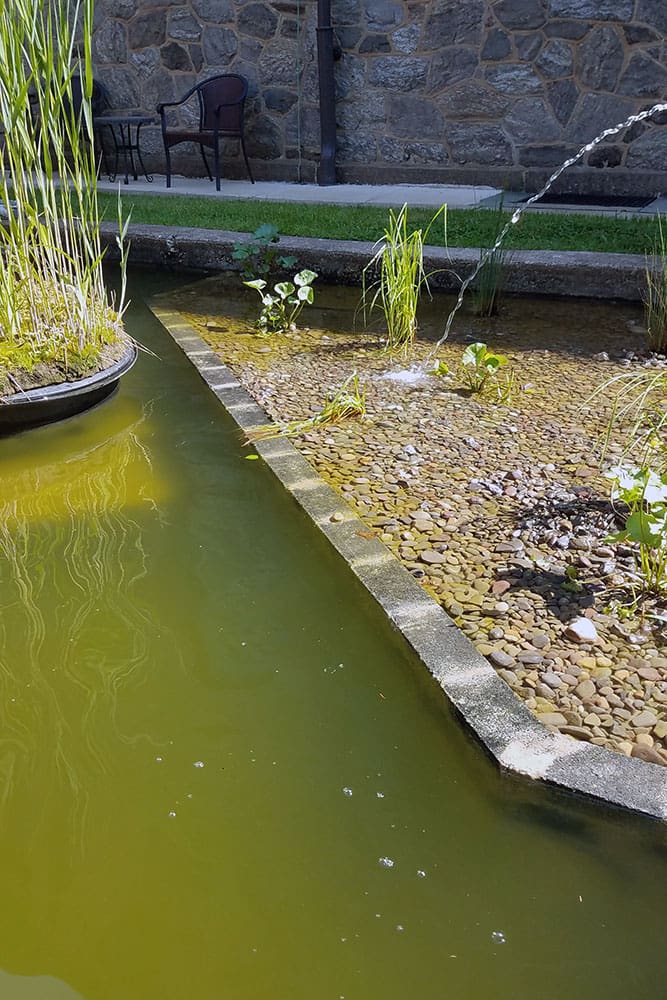
Walk through enough older neighborhoods around Philadelphia and you will find them: concrete ponds built decades ago, often on estates along the Main Line, in Chestnut Hill and across Bucks and Montgomery counties. Some are formal rectangles with stone coping. Some are kidney shaped garden ponds poured in the 1950s and 60s. Many of them have one thing in common. They do not hold water the way they used to.
If you own one of these ponds, or just bought a house that came with one, you are usually facing the same question: can it be saved, and if so, how? The answer is almost always yes, but the right path depends on what is actually wrong. Here is how we think about it.
Why old concrete ponds start to leak
Concrete is strong, but it is not flexible, and our winters are hard on anything that cannot flex.
Freeze and thaw. Water works its way into tiny cracks, freezes, expands and widens the crack a little more each year. After a few decades of that, hairline cracks become real leaks. Ice pushing against straight walls adds to it, which is something we cover in detail in what ice does to formal pond walls.
Settling. The ground under a pond moves over time. When one section settles more than another, the slab cracks along the line where it is being pulled apart.
Failed joints and coatings. Many older ponds were sealed with a coating or paint that has long since worn away, and the joints between the floor and walls are a common weak point.
Roots. Trees that were saplings when the pond was built are now mature, and their roots can lift and crack a slab from below.
First, figure out where the water is going
Before deciding anything, you need to know whether the pond is actually leaking or just losing water to evaporation and splash. In summer a pond can lose a surprising amount of water to the air alone. Our post on pond evaporation vs a leak walks through a simple test.
If it is a real leak, the next step is finding it. With concrete ponds the leak is often in one of three places: a crack in the shell, the joint where the walls meet the floor, or the plumbing that runs through the concrete. How to find a pond leak explains how the search works, and what happens after we find the leak covers the repair side.
Your three real options
Once we know what is wrong, most concrete ponds fall into one of three paths.
1. Repair the concrete
If the shell is mostly sound and the problem is one or two cracks or a failed joint, a targeted repair can make sense. The crack is opened up, cleaned and filled with a material made for underwater use, and the surface may be recoated.
The honest limit of this approach is that concrete that has started cracking from freeze and thaw usually keeps cracking. A repair can buy you good years, but on an older pond it often turns into a recurring project rather than a permanent fix.
2. Reline it
For many old concrete ponds, this is the best balance of cost and longevity. The concrete stays where it is and becomes the structure, and a flexible rubber liner goes inside it over a protective underlayment. The liner does the waterproofing, and because it flexes, small movements in the concrete behind it no longer turn into leaks.
Relining keeps the shape, the coping and the character of the original pond, which matters a great deal on a formal pond that was designed to match the house. The details are what make it work: how the liner is folded into square corners, how it is finished under the coping so it stays hidden, and how the plumbing passes through it. New liners carry the manufacturer's warranty against material defects, and our pond liner guide explains what makes one last.
3. Rebuild or redesign
Sometimes the old pond is not worth saving in its current form. The shell may be badly broken, the depth may be wrong for what the owner wants now, or there may be no filtration at all, which is common in older concrete ponds that were built as reflecting pools and have struggled with green water ever since.
A rebuild does not have to mean losing what you love about the pond. We can keep the footprint and the formal lines, or use the opportunity to turn a tired concrete basin into a naturalistic ecosystem pond. If you are torn between those two styles, formal vs naturalistic ponds is a good place to start.
How we decide which path fits
When we look at an older concrete pond, these are the questions that steer the recommendation:
- How many cracks are there, and are they moving? One stable crack is a repair. A web of cracks is a reline or a rebuild.
- Is the shell structurally sound? Concrete that has heaved, shifted or broken into separate pieces cannot be trusted as a base, even under a liner.
- What do you want the pond to do now? Fish need depth, circulation and filtration that many older ponds were never built to provide.
- How important is the original look? On a historic property, keeping the coping and the shape is often the priority, and that points toward relining.
- What does the rest of the system look like? An old pond often has old plumbing and no skimmer or biological filter. If those need replacing anyway, it changes the math.
When both a repair and a renovation are realistic, we lay them out side by side so you can see the tradeoff clearly. Our post on pond renovation vs pond repair explains how we think about that choice.
What to avoid
A few common approaches tend to cause more trouble than they solve:
- Painting over cracks. Pond coatings are not designed to bridge moving cracks. The leak usually returns within a season or two.
- Patching without finding the actual leak. It is easy to fix the most visible crack and miss the one that is losing the water.
- Ignoring the plumbing. On older ponds, pipes through the wall or floor are often where the water goes, and no amount of work on the shell will fix that.
- Draining it and leaving it empty. An empty concrete shell is exposed to freeze and thaw from both sides and can deteriorate faster than a full one.
Old ponds are worth saving
Many of the most beautiful ponds in our area are the old ones. They were built with stone and proportions you rarely see in new construction, and with the right repair or renovation they can easily outlast the next generation of owners. Our formal pond work and pond renovations are built around exactly this kind of project, and repair and leak work is warrantied for one year, including on ponds we did not build.
If you have an older concrete pond that will not hold water, or you are not sure what you are looking at, Start a Conversation or call us at 215-880-6811. We start with a free phone call, and we will tell you honestly whether it needs a patch, a new liner or a fresh start.