
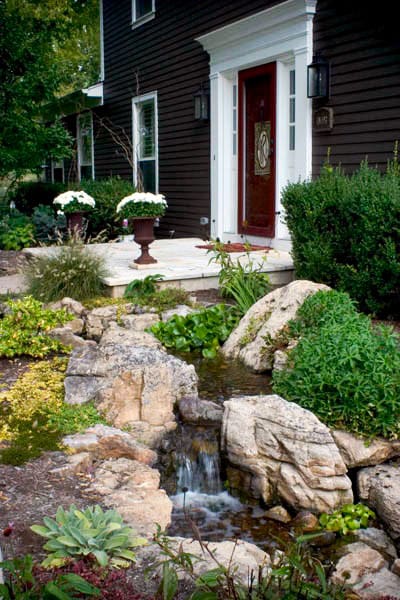
The waterfall is usually the part of a pond people love most. It is the sound you hear from the patio and the movement that catches your eye from the kitchen window. So when it slows to a trickle, or starts running down one side instead of across the whole spillway, it is hard to ignore.
The good news is that most weak waterfalls come down to a short list of causes, and many of them are easy to fix. Here is how to work through it, from the simple checks to the problems that need a closer look.
Start with the water level
Before you look at anything else, look at the pond. If the water level has dropped, the skimmer may be pulling in air along with water, and the pump cannot move what it cannot reach.
A pump that runs with a low water level is working hard and getting little done, and if the level drops far enough it can run dry and overheat. Top off the pond and see whether the flow comes back. If it does, the next question is why the water went down. Our post on pond evaporation vs a leak helps you tell normal loss from a problem.
Check the skimmer
The skimmer is where water enters the system on its way to the pump, and it is the most common place for a flow problem to start.
- The debris net or basket is full. In fall this can happen in a single day. A packed basket starves the pump of water.
- The filter mats are clogged. Mats that have not been rinsed in a while can block most of the flow, especially in summer when biological growth is heavy.
- The weir door is stuck. The floating flap at the skimmer opening can jam closed, especially if leaves are caught behind it.
Clean the net, rinse the mats in pond water rather than tap water so you do not kill the beneficial bacteria, and make sure the weir moves freely. If you want a better sense of how the pieces fit together, our explainer on how pond filtration works walks through it.
Look at the pump intake
If the skimmer is clean and the water level is right, the next stop is the pump itself. Pumps often have an intake screen or cage that can get packed with string algae, small leaves or debris that slipped past the net. A partly blocked intake reduces flow even when the rest of the system is clean.
While you are there, listen. A pump that is grinding, humming without moving water, or cycling on and off is telling you something. Those signs, and when a pump is worth repairing versus replacing, are covered in our post on pond pump repairs.
Check the biological filter at the top of the falls
Water usually comes out of a biological filter box at the top of the waterfall before it spills over the rocks. Inside are filter mats and media that slowly fill with sediment. When they clog, water can back up in the box and overflow at the sides instead of going over the spillway, which looks like a weak waterfall even though the pump is doing its job.
Rinsing the media and clearing settled sludge from the bottom of the box usually solves it. This is part of a normal spring cleanout, and it is one of the reasons a pond that has gone a year or two without one starts losing flow.
Water going over the side instead of the spillway
Sometimes the flow is fine, but the water is not going where it should. Instead of a clean sheet over the spillway stone, it runs off one corner, or the pond level keeps dropping while the waterfall is running.
That usually points to the stream or waterfall itself:
- Rocks or debris have shifted and are diverting water toward the edge.
- Leaves or plants have built up in the stream, creating small dams that push water sideways.
- The liner edge has settled under the stream, so water escapes over the top of the liner and into the soil.
That last one is a leak, and it is one of the most common places ponds lose water. If the level drops only while the waterfall runs, the stream is the first place to look. How to find a pond leak explains how to narrow it down.
Plumbing problems
If everything above checks out and the flow is still weak, the problem may be in the pipe between the pump and the waterfall. Kinked or crushed flexible pipe, a fitting that has worked loose, or a check valve that is stuck can all reduce flow. After a hard winter, freeze damage to plumbing that was not protected can also show up in spring, which is something to think about when you decide whether to run your waterfall through winter or shut it down.
When the pump is simply the wrong size
Some waterfalls were never strong to begin with. If a pump was undersized for the height and width of the falls, or if someone has made the waterfall taller or wider since it was built, the pump may be running flat out and still not delivering the look you want.
A pump is rated for how much water it moves at a certain height, and every foot of lift reduces the flow. A waterfall that looks thin across a wide spillway may simply need more water than the pump can deliver. That is a design issue rather than a maintenance one, and it can often be corrected without tearing anything apart.
When to call for help
You can handle a lot of this yourself: topping off the water, cleaning the skimmer net and rinsing filter mats. It is worth bringing in a professional when:
- The pump is making noise, tripping the outlet, or not running at all.
- The pond is losing water and you cannot find where.
- The filter box at the top of the falls has a thick layer of sludge you cannot reach.
- The waterfall has always been weak and you want it to look the way you pictured it.
Our pond repair team diagnoses flow problems, pumps and leaks, and our maintenance packages keep skimmers, filters and pumps cleaned on a schedule, so the waterfall keeps running the way it should and you are not guessing what went wrong.
If your waterfall has lost its sound, Start a Conversation or call us at 215-880-6811. Tell us what you are seeing, and we will help you figure out whether it is a five minute fix or something worth a closer look.